


Ely Stone Bridge Masonry Investigation
Iowa's last three-arch stone bridge, and the assessment that found what's destroying it.
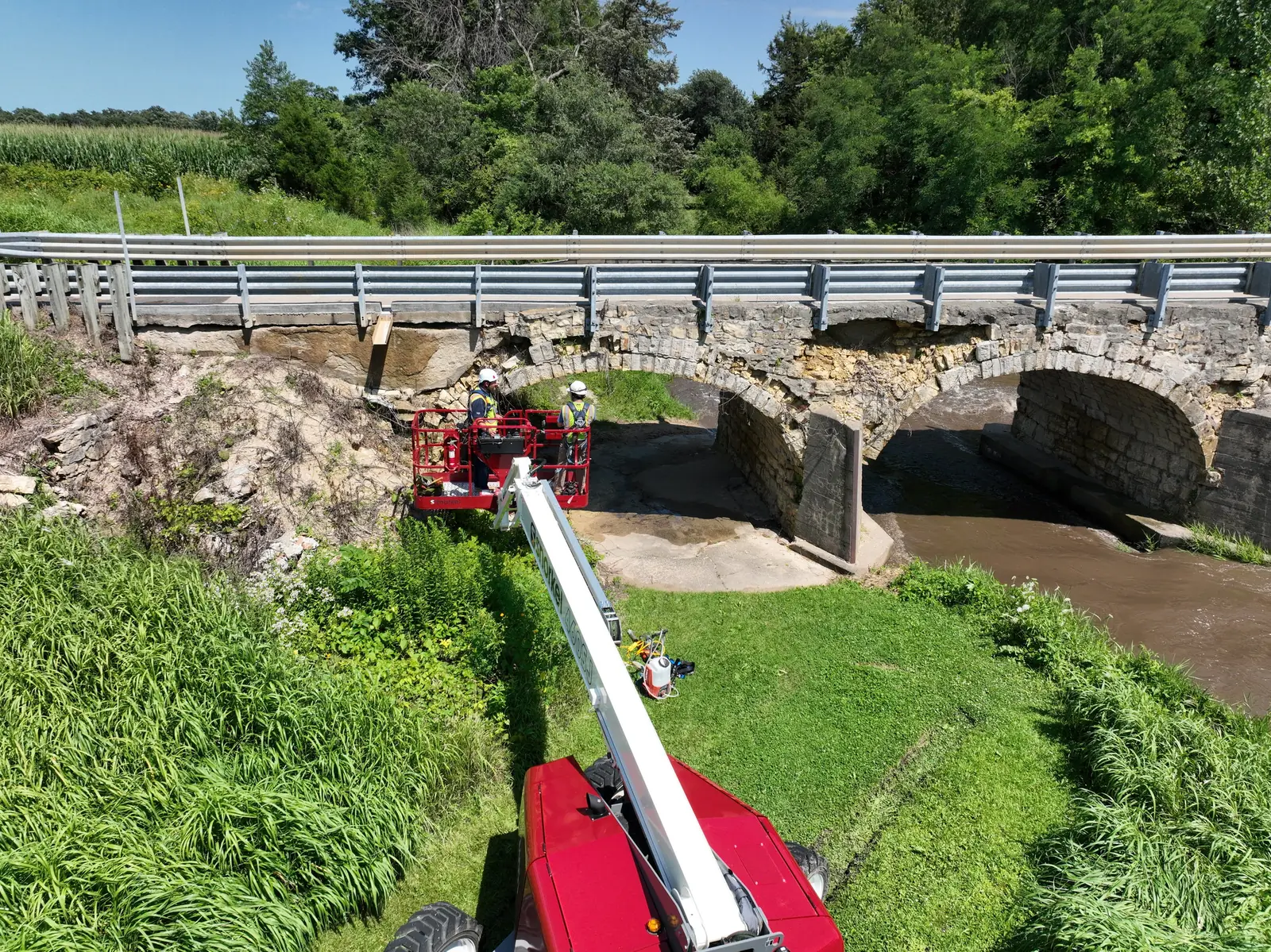
Sound arches. Failing faces. A budget they can raise against.
Quick Answer: Ely's Stone Bridge is an 1893 limestone arch bridge outside Monticello, Iowa — the only three-arch stone bridge left in the state. It is listed on the National Register, closed to vehicle traffic, and managed by the Jones County Historic Preservation Commission. Before committing to a restoration budget, the Commission commissioned a condition assessment. WJE served as engineer of record; TNT provided the access and documentation on site, then developed the costs, shoring, phasing and schedule the Commission needed to fundraise. The finding: the arches are structurally sound, but the outer band of stone is failing fast, and the bridge is now in poor condition and requires immediate repairs. The Commission is entering fundraising for a phased restoration, targeting Spring 2027.
The structure
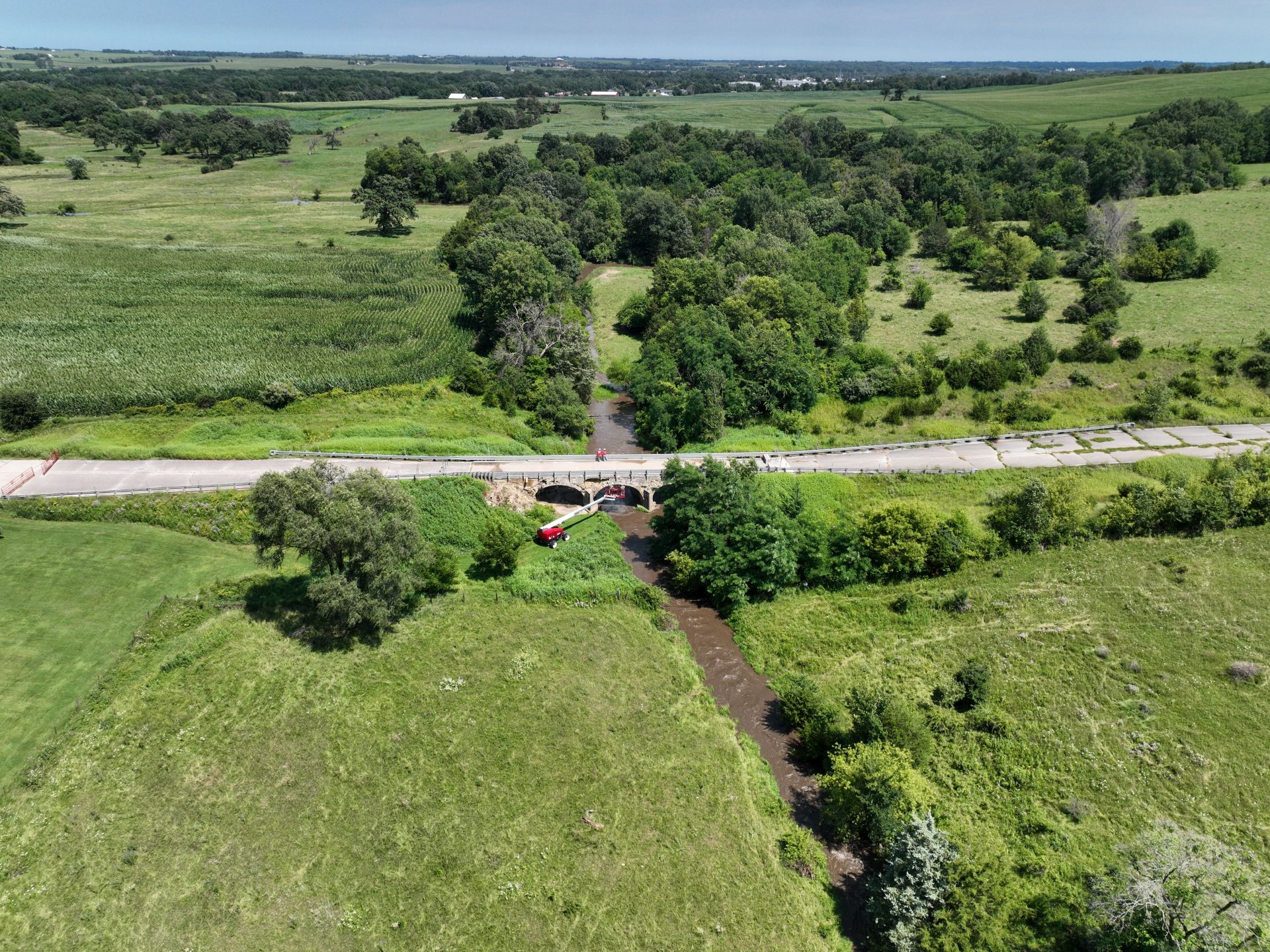
Reuben Ely Sr. and his son Reuben Jr. built this bridge in 1893, funded with public money — the county's contribution was four hundred dollars. Three elliptical arches, approximately 90 feet long and 20 feet wide, carrying Stone Bridge Road over Deer Creek in Lovell Township, a mile northwest of Monticello.
They built it out of what was there. The spandrel walls and piers were laid up from stone pulled straight out of the creek bed. The voussoirs — the wedge-shaped stones that form the arch rings — are Anamosa limestone, a dolomitic limestone quarried a few miles away at Stone City, the same beds that supplied courthouses and churches across eastern Iowa.
Look at how they turned the arches. Each one is two courses of voussoirs deep, with no keystone. Nothing at the crown to lock it. Every stone in the ring is carrying its neighbors, and the ring holds because the geometry is right and the cutting is accurate. That is not a shortcut. That is a mason who knew exactly what he was doing.
Stone arch bridges were never common in Iowa and almost none survived. The Iowa DOT's historic stone arch inventory lists ten structures in the entire state, and most are culverts and railroad underpasses. Ely's Stone Bridge is the only three-arch stone bridge left in Iowa.
It was listed on the National Register of Historic Places on March 7, 1979. The nomination called it "locally significant as an example of a form of bridge construction which is quite unusual in Iowa," and described the three elliptical arches as an unusual variant of an already rare type.
Who built it, and who has been keeping it
Reuben Ely Sr.'s family came out of Bucks County, Pennsylvania and had been in the area since 1820. He was an old man when he built this bridge with his son. He died in 1895, two years after it was finished, and the two of them are buried at Oakwood Cemetery in Monticello, about a mile and a half from the arches they set.
Then there is the part of this story that ought to be better known, and it appears in both the National Register nomination and WJE's 2026 assessment: the bridge was maintained by the Ely family for four generations following construction. Every one of them a stonemason. A century of one family's masons keeping up their great-grandfather's arches, on a gravel road, over a creek in Jones County.
That is worth sitting with if you work in this trade. When TNT gets on this structure, we will not be the first masons to take care of it. We are the ones whose turn it is. Our owner Josh Smyser wrote about what that means, and about the people who keep structures like this standing, in Nobody Decides to Lose a Building.
Plenty of others have carried it too — Jones County, the State Historic Preservation Office, and a 2016 condition assessment by a research team from the University of Colorado Denver working with Cedar Rapids architect Douglas Steinmetz. In 2017 the Jones County Historic Preservation Commission took on the management of the bridge through the Jones County Supervisors, so the Commission could take on the restoration and the fundraising behind it, and access to vehicular traffic was closed at that time. Commissioners David Balster and Dean Zimmerman have been heavily involved in the effort since.
Why the Commission started with an assessment
Before committing to a restoration budget, and before going out to raise a dollar against it, they paid to find out what was actually wrong.
That order matters more on a structure like this than on almost anything else we work on. A stone arch bridge will not tell you what it needs from the road deck or from a photograph. The conditions that drive the cost live in the joints, in the arch rings, in the spandrel walls and in the fill behind them. The only way to know is to get on the structure and document it.
Guessing produces a number that falls apart the first time somebody qualified looks at it. That is a bad position to be in after you have already told donors what it will cost.
How the team came together
Axiom Consultants, out of Iowa City, brought TNT onto this project first, on the strength of our historic masonry background. As the work progressed and the scope came into focus, it was clear the structure would benefit from a firm with deep experience in this specific kind of preservation and forensic engineering. We recommended WJE — Wiss, Janney, Elstner Associates — and Axiom were open and welcoming about handing it off. Plenty of firms would have held on. The Commission saw the value and brought WJE into the fold.
WJE came on as engineer of record and engaged TNT to provide the masonry investigation support services alongside them. They did not send a generalist either. Matthew Jarrett, a professional engineer licensed in Iowa, and Nathan Harres, a registered architect — a bridge engineer and a historic preservation architect on the same structure, which is what a National Register stone arch bridge actually needs.
Everybody in that chain named what they were good at and what they were not, and the Commission ended up with a better team than any one of us would have assembled alone. More on why that combination is rare, and what it is worth, in our WJE vendor spotlight.
How the assessment was run
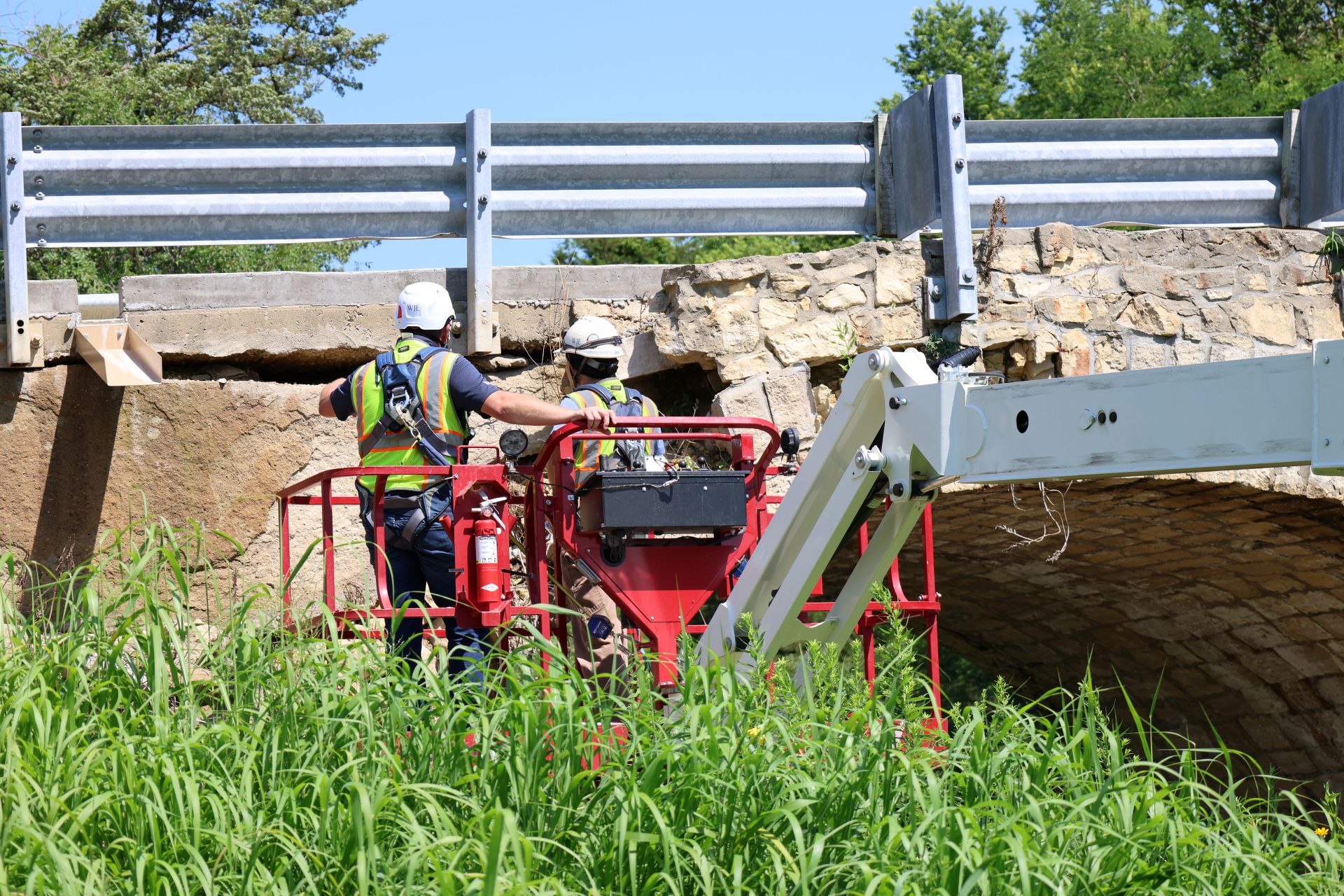
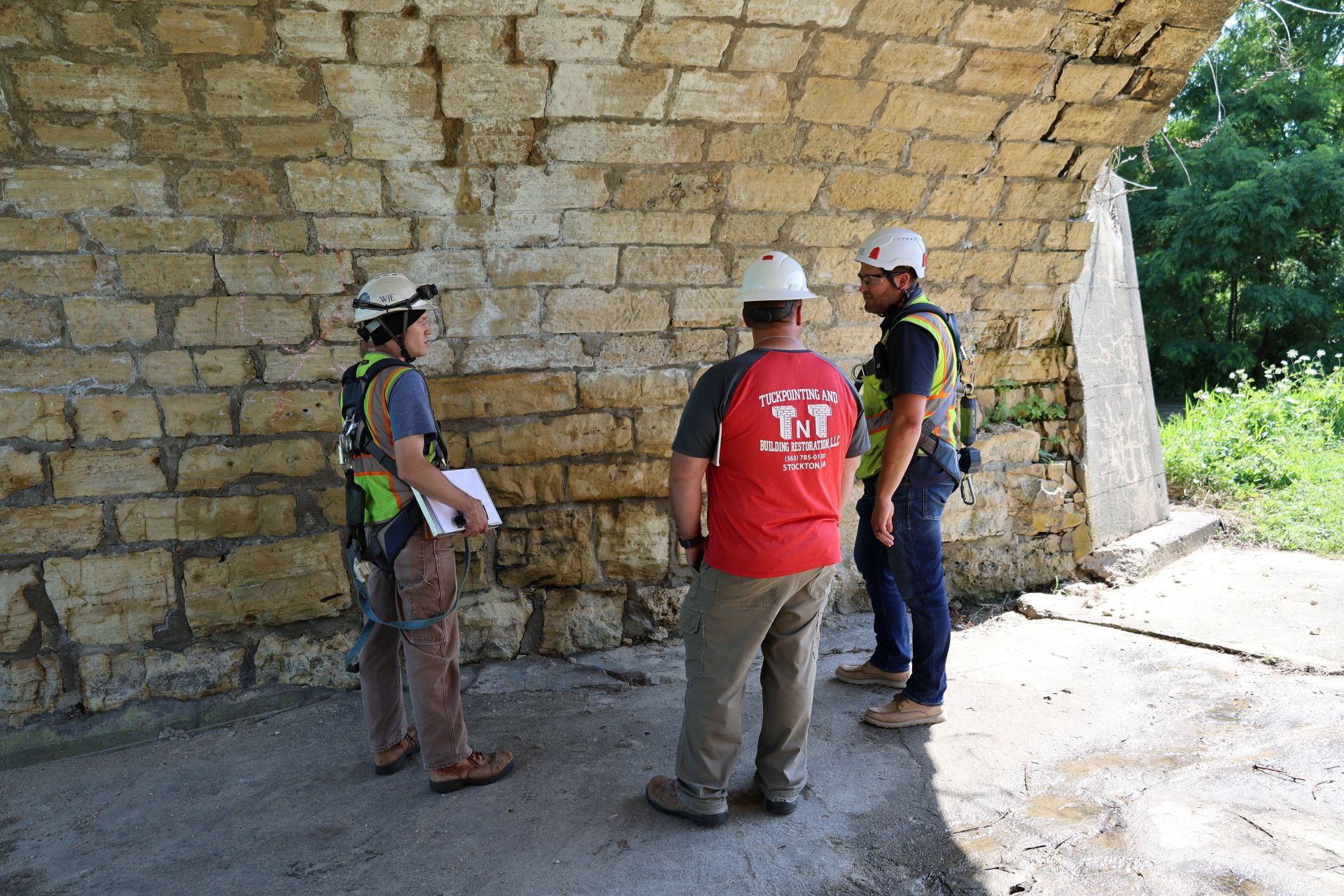
It is worth being precise about who did what. WJE performed and authored the condition assessment, on site across two days in July 2026. TNT provided the aerial lift that got them onto the west elevation, operated the drone that documented the east elevation and the south end, and extracted mortar samples alongside WJE. Engineering and architectural judgment from the design professionals. Access, masonry judgment and constructability from the contractor who will have to build it.
Behind that sits roughly 930 photographs across five sets, including two full drone surveys at 419 frames each. Drone work on a bridge earns its cost immediately — it captures the arch soffits, the spandrel faces and the deck edges from angles no lift will reach. But drone imagery is documentation, not assessment. It tells you where to put your hands. The hands still have to go there.


What the assessment found
The good news first, because it is the finding that makes restoration worth doing. The arches are sound. In WJE's words, the limestone arches inboard of the failing outer band "appear to be intact, sound, and do not exhibit displacement or indications of global structural movement." The lower of the two voussoir courses — the one actually carrying the bridge — "remains generally sound." Reuben Ely's arches are still doing their job after 133 years, and for the bridge's future as a pedestrian crossing, WJE found the structure's capacity adequate.
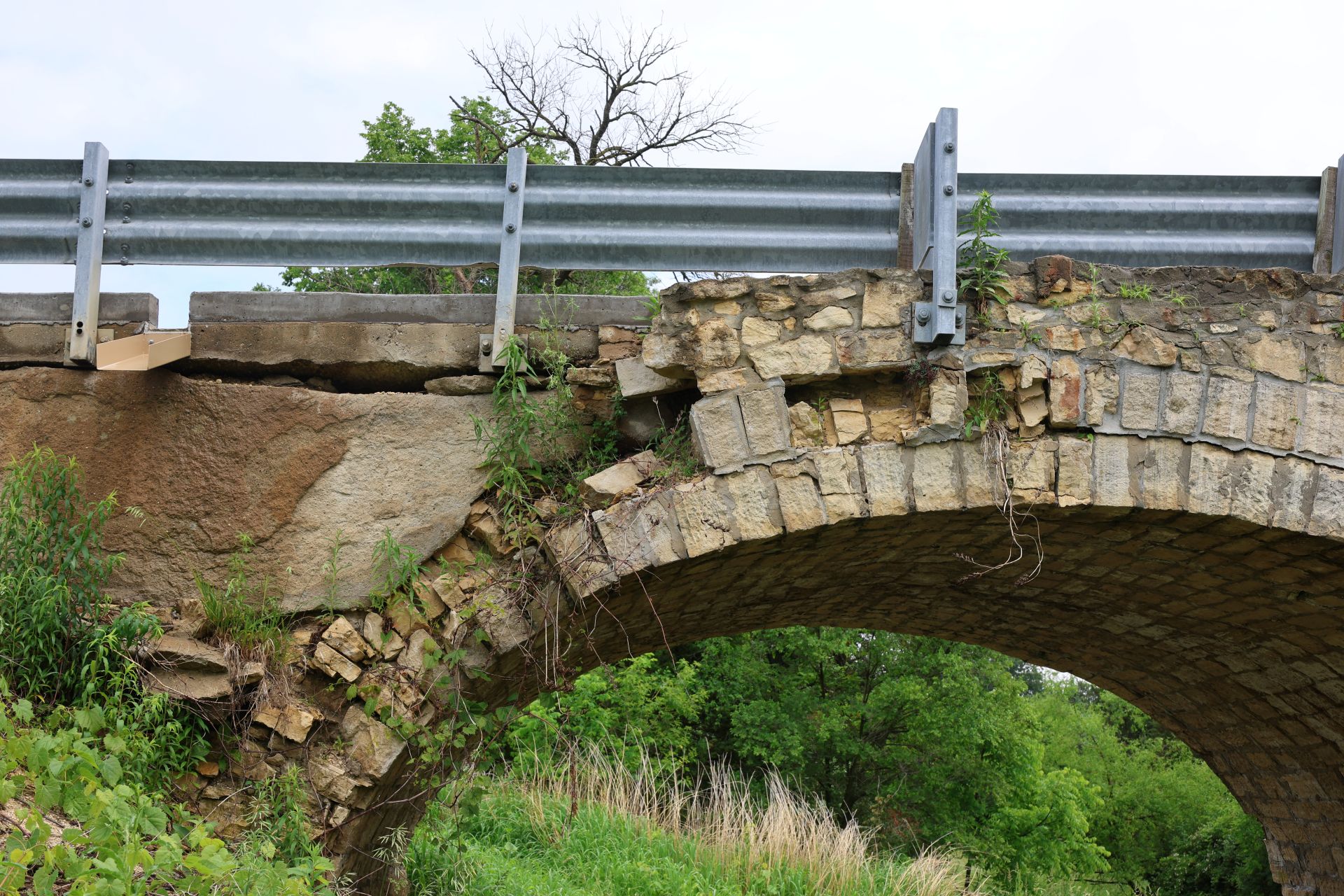
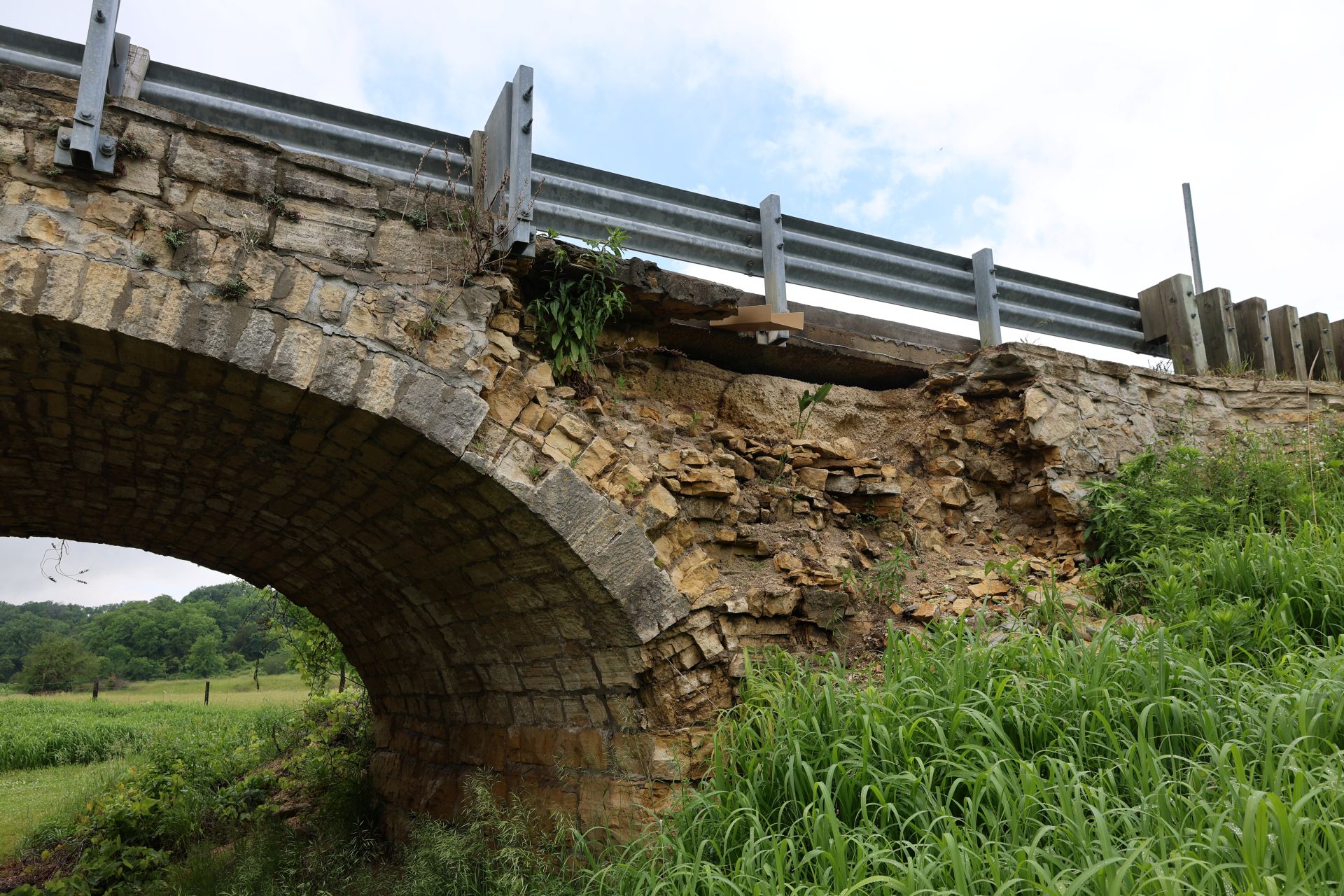
The damage is in the outer 20 to 24 inches — the spandrel walls, the parapets and the arch faces. That dimension is not arbitrary. It corresponds exactly to the thickness of the spandrel wall and parapet standing above the deck, and the heaviest mortar erosion sits right at the joint between the edge of the concrete deck and the stone parapet.
Which points straight at the cause.
Water, and two well-meant repairs
WJE's finding is that the deterioration is "primarily attributable to long-term moisture infiltration and freeze-thaw cycling of entrapped water." Water gets in, freezes, expands, and works the stone apart from the outside in.
Two modern interventions made that dramatically worse.
In 2003 the original gravel roadway was replaced with a concrete deck slab. That changed where the water went. Runoff was directed toward the joint between the new deck and the limestone parapets — straight into the assembly, at exactly the place the damage is now worst.
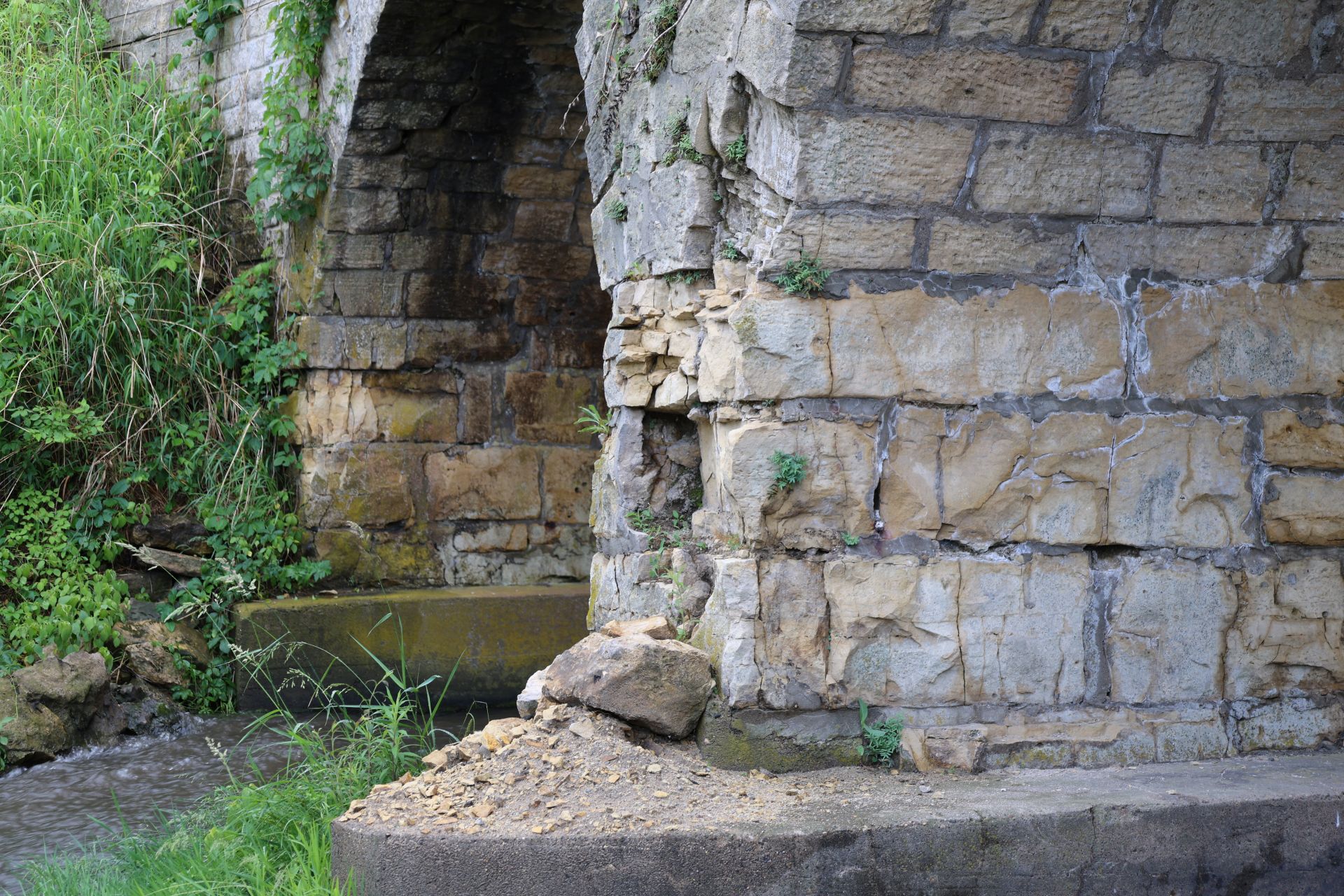
Then the joints were repointed with a modern cement-based mortar. Laboratory testing had established that the original was a lime-sand mortar with no Portland cement in it at all. The replacement is harder and less permeable than the stone around it. WJE found it applied over the surface of the joints with minimal penetration — and still very difficult to remove. A mortar like that alters how load transfers through the stonework, causing localized cracking and spalling, and it holds moisture inside the masonry, which makes the freeze-thaw damage worse rather than better.
So: a slab that sent the water in, and a mortar that would not let it back out. Both repairs were meant to protect this bridge. Between them they have been taking it apart. The worst of it shows at the piers and abutments, where the softer creek-bed limestone is more vulnerable than the harder Anamosa stone in the arches.
The rebuild will use a mortar compatible with the original lime-sand — softer than the stone, breathable, the way it was built.
And it is accelerating
This is the part that should concern anyone who cares about this bridge. Comparing the current conditions against the 2016 photographs, WJE found that deterioration "has accelerated significantly, including the collapse of limestone at three locations that remained intact in 2016."
Three collapses in ten years, on a structure that stood for the previous 123. At the north arch the spandrel has gone entirely within the outer two feet of the wall, leaving the deck edge and guardrail over open air. WJE's conclusion is blunt: the bridge "is in poor condition and requires immediate repairs."
This is not a structure to go visit right now. WJE advised the Commission that the unstable limestone at the east and west elevations presents a potential overhead hazard, and that it cannot be temporarily stabilized without large-scale demolition. Their recommendation was to restrict public access on all sides until the long-term repairs are complete. We would ask people to respect that. There is stone at the faces of this bridge that is no longer attached to anything, and a photograph from underneath the north arch is not worth what could come down.
What we did once the report was in hand
A condition assessment tells an owner what is wrong and what the repairs have to accomplish. It does not tell them what the work costs, how long it takes, or whether a given sequence can be built at all. Those gaps are not small ones, and the Commission could not launch a campaign against a report alone.
That is the part we picked up. Working from WJE's findings, we developed budgeted costs for the restoration scope, rough costs for the temporary shoring, a phase-by-phase breakdown, and the schedule implications that came with each phase — what a crew can accomplish in one season, what has to wait on stone fabrication, and what it means to carry an opening through a winter.
The shoring deserves its own mention, because it is the number owners are most likely to underestimate. Supporting three elliptical arches over a live creek while the outer band of stone comes off is temporary work, but it is not minor work, and on a job like this it can approach the cost of the permanent repairs. A restoration budget that does not carry a real shoring number is not a budget. Putting an honest figure on it early changed the shape of what the Commission is raising toward.
The part that mattered most was not a document
Through the investigation and after it, we were on the structure and on the phone answering means-and-methods questions. How would you actually do this?
How do you get equipment to a bridge at the end of a closed gravel road, over a creek. How do you take the outer twenty inches off a spandrel wall without losing the arch behind it. What holds the arch while it is open. Which stones come off, get catalogued and go back, and which are too far gone to reset. How much of that can one crew get done between spring thaw and freeze-up.
Those questions have real answers, and the answers move both the repair approach and the number. They are also not questions a report can answer on its own. Means and methods belong to the contractor — that is true contractually, and it is true practically, because the party who has to build it is the one who knows what building it takes. Having that voice in the room while the repair approach was still taking shape is the difference between a scope that looks right on paper and a scope that can be executed on a 133-year-old arch bridge for a price somebody will stand behind.
It is also why WJE's recommendation on delivery reads the way it does: a coordinated approach between engineer and contractor, "more akin to design-build," with conceptual repair documents from WJE and revised detailing as concealed conditions are exposed. On a structure where nobody knows exactly what is behind the wall until it comes apart, that is the honest way to run it.
What the Commission has now
A written condition assessment from a national engineering firm. A ten-item preliminary restoration scope. A phasing sequence that starts at the north end and terminates each phase above a pier, so no phase ever leaves an arch half-supported. Budgeted costs and a schedule behind each of those phases. And replacement stone available out of Stone City, from the same beds the original voussoirs came from in 1893.
That is a package a donor or a grant reviewer can evaluate. It is a very different thing from a photograph and a hope.
What comes next
The Commission is entering fundraising in earnest, and the target for the first restoration work is Spring 2027.
That campaign is the whole ballgame. Every winter between now and mobilization is another freeze-thaw season on stone that is already failing, and WJE has been explicit that conditions will worsen. What the Commission has going into it is the thing most preservation campaigns lack: a documented condition assessment, a defined scope, and a budget somebody qualified stands behind. Donors and grant reviewers can see exactly what they are funding and why the timing matters.
Spring 2027 is preparation — shoring the arches, careful disassembly and salvage of the outer band, trial repairs, mock-ups and approvals. Stone gets fabricated over the summer. Fall 2027 is the rebuild. Later phases follow as funding is secured.
If you want to help keep this bridge standing, there is a way to do it. A 501(c)(3) has been set up to fund the project through the Natural & Cultural Heritage Foundation of Jones County Area. Donations can be sent to 309 E. 1st Street, Monticello, IA 52310. The contact for the campaign is David Balster at 319-465-4415 or davidbalster@gmail.com.
The takeaway
An assessment is not a delay before the real work. It is what makes the real work fundable, defensible and correctly scoped — and it only gets there when somebody prices it, phases it and answers how it will actually be built. The Commission has a documented condition report and a scope that will hold up when a funder asks hard questions about it. Going into a capital campaign, that is worth more than any estimate ever produced from the ground.
Read the full walkthrough of how an investigation is run in Anatomy of a Masonry Investigation, and see how we approach this on every structure in Investigation & Budgeting and Historic Preservation.
Have a structure you need to understand before you fund it? Request an assessment or call (563) 785-0120.
Contact Us
Our skilled team is here to bring your building to life. Contact us today to discuss your project!