


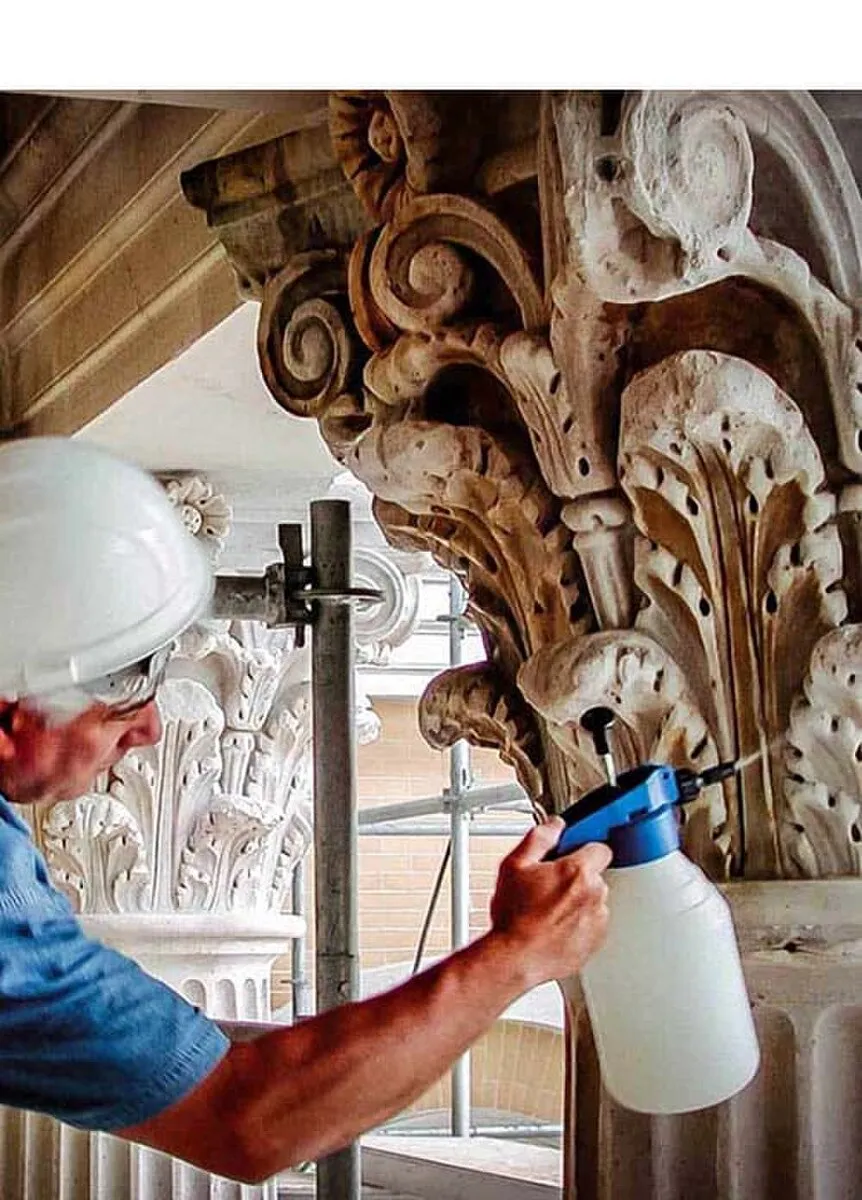
Preserving Friable Historical Stone
Strengthen and stabilize decaying, crumbling, or "sugaring" historic stone using advanced chemical consolidants that restore structural matrix cohesion.
- Deep-penetrating treatments that chemically re-bind loose minerals.
- Maintains the stone’s original vapor permeability and breathability.
- Arrests severe weathering without altering the stone's historic appearance.
Why Stone Consolidation Matters
On historic buildings the original stone is often irreplaceable, since the quarry may be closed or the carving impossible to reproduce. Consolidation extends the life of that material and respects the building's historic fabric, which matters both for preservation standards and for the building's character.
- Preserves historical heritage by stabilizing original masonry units
- Protects building structure
- Enhances building appearance
- Avoids replacing irreplaceable carved or quarried material.
- Slows or arrests surface loss and crumbling.
- Supports compliance with preservation guidelines.
How TNT Approaches Stone Consolidation
We assess the stone type, the depth and nature of deterioration, and the conservation goals before selecting a treatment. As preservation specialists and members of Preservation Iowa with decades of historic work, TNT approaches consolidation as a measured conservation decision, not a one-size-fits-all coating.
When Stone Consolidation Is Appropriate
Consolidation is one tool among several; severely deteriorated stone may instead call for patching, dutchman repair, or replacement.
- Stone surfaces powdering, flaking, or shedding grains
- Soft, friable stone that crumbles under light pressure
- Eroding carved detail on historic facades
- Sugaring or granular disintegration of sandstone and similar stone
FAQs
What is stone consolidation?
How is stone consolidation performed?
How long does stone consolidation last?
How much does stone consolidation cost?
What are the signs that stone needs consolidation?
Does TNT use consolidation on limestone and sandstone?
Can consolidation restore structural integrity to damaged stone?
When is stone consolidation a better option than stone replacement?
Is stone consolidation appropriate for historic or landmark buildings?
What is the difference between stone consolidation and stone patching?
What types of stone can be consolidated?
What causes stone deterioration on commercial buildings in the Midwest?
Contact Us
Our skilled team is here to bring your building to life. Contact us today to discuss your project!