


Vendor Spotlight: WJE, The Team Behind the Ely Stone Bridge Assessment
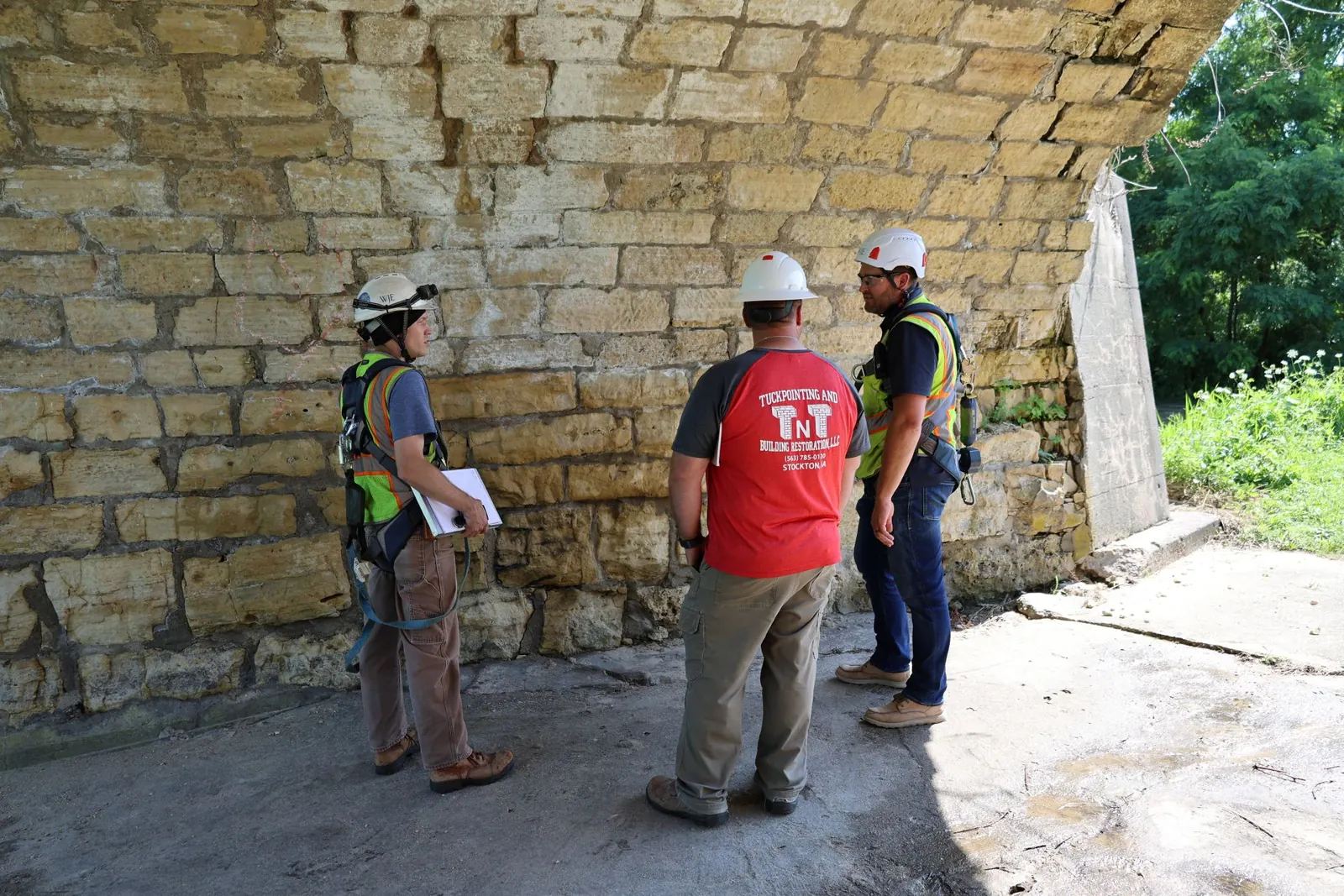
Quick Answer: WJE — Wiss, Janney, Elstner Associates — is a national firm of engineers, architects and materials scientists founded in 1956. What made them the right call for Ely's Stone Bridge is a combination you do not see often: deep historic preservation experience and a serious structural engineering practice inside the same firm, backed by work on difficult structures all over the country. When the scope came into focus, we recommended them to the owner. WJE came on as engineer of record, and TNT is providing the masonry investigation support services alongside them. Ely's Stone Bridge is the first project we have worked on together. It is not the first time this firm has taught us something, and that is much of what this article is about.
Most of our vendor spotlights are about products. This one is about people, because on the hardest projects the thing we depend on most is not a material.
Good masonry restoration is not just knowing what a wall needs. It is knowing where your own expertise ends.
How a contractor and a design professional end up on the same job
There are three ways this happens, and they do not all run the same direction.
Most of the time, they bring us in. An architect or engineer has an owner with a failing building, a repair approach that needs field validation, or a scope that has to be priced before anybody commits. We get the call because somebody on the design side wants a contractor's answer to a constructability question, or wants the work executed by people who have done it before. That is how most of our historic and institutional projects start.
Sometimes we bring them in. An owner calls us first, usually because they can see something failing and we are the masonry name they know. If what we find points past the wall — at movement, at settlement, at load — the right answer is not for us to price a repair. It is to tell them they need a design professional, and then to say who.
And sometimes the specialist comes in behind the design team. A firm like WJE is often engaged as a subconsultant to the architect or engineer already on a project, to take the piece of it nobody else on the team is set up for: a historic masonry facade, a terra cotta program, a stone arch bridge. The design team stays in place. The specialty firm goes deep on the part that needs it, and brings whichever disciplines that part actually calls for.
All three rest on the same thing, and we put it on every investigation page: TNT is a masonry restoration contractor, not a design professional. There is a lot we know cold. Thirty-three years in, we know what failing masonry looks like, what caused it, and what it takes to put it right. What we do not do is stamp a design, and we are careful not to blur the two.
What people outside this work do not expect is how much traffic runs the other direction once everyone is on the job. Design professionals ask us how a detail actually gets built — what the access looks like, whether a sequence is possible, what it costs to do it that way instead of this way. We ask whether the approach is sound and what it needs to be sound. Neither answer is worth much alone.
Why this firm, for this bridge
Most masonry problems do not need a firm like WJE. Ely's Stone Bridge did, and it is worth explaining why, because the reason is not size and it is not reputation.
A National Register stone arch bridge asks two questions at once, and they pull against each other. The first is a preservation question: what is this structure, what is original to it, and what will the Secretary of the Interior's Standards actually allow you to do to it. The second is a structural question: is it stable, what is carrying load, and will it stand while you take part of it apart. Answer only the first and you get a careful repair on a bridge nobody can prove is safe. Answer only the second and you get a sound structure that has lost the thing that made it worth saving.
Most firms are honestly built for one or the other. There are preservation architecture practices that know lime mortar, historic assemblies and the review process cold, and there are structural and bridge engineering firms that can run the numbers on an arch. Finding both, at depth, inside one firm and pointed at the same structure is not common. That is the combination this bridge needed, and it is the specific reason we put WJE's name in front of the Commission.
There is a third piece that gets less attention and mattered just as much here. WJE runs its own materials laboratory. The finding that the original mortar contains no Portland cement is not a field opinion — it came out of a lab. On a project that will be funded by donors and grants, the distance between we believe and we tested is the distance between a scope that survives review and one that does not.
And this is not an org chart claim. WJE has run this same sequence on historic arch bridges before. On the Franklin Avenue Bridge in Hennepin County, Minnesota — a National Register-listed five-span open spandrel concrete arch over the Mississippi — they performed the complete visual survey and in-depth examination, took material samples to the laboratory, ran the structural analysis to confirm load-carrying capacity, and developed rehabilitation alternatives with service life and cost estimates, then carried the rehabilitation design through construction. Different material, same sequence. That is the arc this bridge is on, one phase further along.
Ely's Stone Bridge is a small bridge in a creek bottom outside Monticello, Iowa. It got the same method.
What a firm like WJE brings
Judgment about what is likely needed, before anybody draws anything. It is worth being clear about what phase this project is in, because it is the phase most owners misunderstand. An investigation is not design. On this bridge, WJE assessed the structure and identified what the repairs will likely involve, and we worked alongside them on what those repairs would take to build and what they would cost. Between the two, the owner gets answers to the questions they actually have right now: is this bridge repairable, what methods would a repair likely use, and what order of money are we talking about. There are no repair drawings at this stage, and there should not be. You do not detail a repair you have not decided to fund.
Stamped design when the project gets there. If the Commission funds the work, the next phase is a different animal. Some repairs are selected from experience. Others have to be designed, calculated and signed — anchoring a wall that has moved, rebuilding a load-bearing element, designing the temporary works that hold a structure up while you take part of it apart. That is design work, and we do not freelance it. On a project like this the engineer issues the structural loads the shoring gets designed to and reviews the shop drawings against them, and we build to the design. This is the backbone of how we approach facade stabilization and the structural end of masonry and concrete restoration.
Diagnosis when the cause runs past the masonry. Our investigation and budgeting work exists to tell an owner what is actually wrong before they spend a dollar on it. Most of the time the answer lives in the masonry and we can document it ourselves. Sometimes what we find points past the wall. When that happens the honest move is to bring in a design professional rather than stretch a masonry opinion to cover a structural question. That is what keeps our masonry investigations defensible when they go in front of a board or a funder.
The right disciplines on the actual structure. On historic structures and rare construction, what you want is not somebody with a ready answer. It is somebody with the discipline and the resources to go find the right one — testing the material, analyzing the assembly, and reasoning from evidence rather than precedent. A firm carrying engineers, architects and materials scientists under one roof can put the specific expertise a structure needs on that structure, instead of making one generalist cover all of it. Investigation is not a side practice at WJE. It is the practice.
What we get from them that never shows up on an invoice
Here is the thing about WJE we did not expect, and have come to value as much as the engineering: they teach.
It is not a side interest. Rachel Will, one of their associate principals, carries the title Associate Director of Knowledge Sharing — a role built around capturing what 800-plus engineers, architects and materials scientists learn in the field and making sure it circulates. Much of that points inward, to their own people. A good deal of it flows outward too, and WJE gives back to this industry in a way not many firms bother with.
Our owner, Josh Smyser, has gotten to know Rachel, along with Brett Laureys and Nate Harres, through his involvement with the Sealant, Waterproofing & Restoration Institute. That is where much of this relationship was built, and it is where a great deal of the value sits. WJE takes on demanding work all over the country alongside some of the best restoration contractors in the business — the firms we measure ourselves against. When they bring one of those projects to an SWR meeting, they bring the whole thing: the condition nobody expected, the repair that had to be redesigned mid-job, what the contractor did in the field to make it work.
We bring our own hard projects to those rooms, and the exchange runs both directions. What WJE adds is breadth. A stone arch bridge in Iowa. Terra cotta restoration on a downtown high-rise. Forensic investigation into why a building came down.
That last one is worth sitting with. WJE investigated the Champlain Towers South collapse at Surfside, Florida, where ninety-eight people died. They were retained on behalf of insurers and a court-appointed receivership, and when the civil litigation settled they did not put what they had found in a drawer. They published the analysis in STRUCTURE magazine, ran a public webinar walking through the failure mechanism, and took it to structural engineering associations. The profession got those lessons because a firm decided the knowledge belonged to everybody.
No single firm on either side of this trade covers that kind of range alone. When WJE carries what it learns from one job into a room full of contractors, the rest of us build better for it.
Earlier this year they took it further. WJE partnered with the SWR Institute's Training and Validation Committee to host the 2026 Validated Training Showcase at their Northbrook headquarters — classroom instruction and hands-on application, with industry professionals coming in from around the country. We sent our own people. They came back better at their jobs, and they came back talking about the tour of the Janney Technical Center, WJE's testing lab.
The talk Brett Laureys gave that week was called "Bridging the Gap: Contractors & Consultants." That is the entire subject of this article, and he was giving it to a room of contractors before we ever wrote a word of it.
And it is not only contractors they teach. In June, Nate Harres presented alongside Josh at the Preserve Iowa Summit in Ankeny — "Historic Masonry Restoration: Essential Do's and Don'ts," delivered for AIA continuing education credit to a room of building owners, architects and preservationists. An engineer and a contractor on one stage, walking owners through how to make a sound repair decision before they spend money on the wrong one. You can watch the full session here.
Contractors, crews, building owners, preservationists. That is a pattern, not a coincidence. Every one of those jobs produces knowledge about how a material behaves, how an assembly fails, and what a repair actually did five years later, and a firm could hold all of it as proprietary advantage. Instead they give it away — and this year they handed over their building too.
That is rarer than it should be, and it is worth saying out loud. When WJE puts what they know in front of this industry, the whole trade gets better at it, ours included. We do not take that for granted.
See it in action: Ely's Stone Bridge
Ely's Stone Bridge is an 1893 limestone arch bridge outside Monticello, Iowa, in Jones County — three elliptical arches, approximately 90 feet long and 20 feet wide over Deer Creek, built by Reuben Ely Sr. and his son Reuben Jr. out of rock from the creek bed with dressed Anamosa voussoirs from the quarries at Stone City. It is listed on the National Register, closed to vehicle traffic, and it is the only three-arch stone bridge left standing in Iowa.
This project ran every direction described above, which is why it makes a good example.
Axiom Consultants, out of Iowa City, brought us in first, on the strength of our historic masonry background. They were good to work with from the start. And when it became clear the structure would benefit from a firm with deep experience in this specific kind of preservation and forensic engineering, Axiom were open and welcoming about handing it off. That is worth saying plainly, because plenty of firms would have held on. We recommended WJE. The Jones County Historic Preservation Commission, which manages the bridge, saw the value and brought them into the fold, and WJE came on as engineer of record and engaged TNT to provide the masonry investigation support services alongside them.
Then WJE did the same thing one level down. They did not send a generalist. They put two disciplines on the bridge: a bridge engineer and a historic preservation architect — Matthew Jarrett, a professional engineer licensed in Iowa, and Nathan Harres, a registered architect. On a National Register stone arch bridge you want both. One of them can tell you what the preservation standards will allow. The other can sign for the structure.
That is the idea working the way it should, at every level. Nobody in that chain oversold what they do, and the Commission came out of it with a stronger team than any one of us could have put together on our own.
Harres and Jarrett spent two days on the structure in July 2026. TNT put them on the west elevation with an aerial lift, ran the drone for the east elevation and the south end, and pulled mortar samples out of the joints with them.
Worth being plain about why a team was the right call here. Iowa's entire historic stone arch inventory runs to ten structures, most of them culverts and underpasses, and this is the last three-arch bridge in the state. Local precedent runs out fast on a structure like that. What you want instead is people who have seen enough difficult masonry elsewhere to reason from first principles about the thing in front of them.
What that produced is a diagnosis nobody would have reached from the ground. The arches are sound. The failure is in the outer 20 to 24 inches, and it traces back to two well-meant modern repairs: a concrete deck slab that replaced the original gravel roadway in 2003 and redirected runoff into the joint between the deck and the stone parapets, and a cement-based repointing mortar — harder and less permeable than the original lime-sand mortar, confirmed by laboratory testing — that holds moisture inside the wall and worsens the freeze-thaw damage it was meant to prevent.
Then the finding that changed the project's urgency. Set against photographs from a 2016 assessment, the deterioration has accelerated sharply — three sections of limestone that were intact in 2016 have since collapsed. WJE's conclusion is that the bridge is in poor condition and requires immediate repairs, and their advice to the Commission was to restrict public access until the long-term work is done.
What the Commission holds now is a documented condition report, a preliminary ten-item restoration scope, a phasing sequence that would leave the bridge stable at every stopping point, and an order-of-magnitude budget — enough to know the bridge is repairable, roughly how it would be repaired, and what it would take to fund. That is what they need to run a campaign. The detailed design comes after the money does.
One more thing, and we do not take it lightly. WJE's own recommendation for how the restoration should eventually be delivered is a coordinated approach between WJE and TNT, "more akin to design-build," with conceptual repair documents from the engineer and revised detailing as concealed conditions are exposed. Having the engineer of record recommend how you should work together is worth more than anything we could say about ourselves.
We are glad to be on this one. If the Commission's fundraising goes the way everyone hopes, we will be back on that bridge in the spring doing the work. Partnering with a firm we have learned this much from, on the last three-arch stone bridge in Iowa, is about as good as this trade gets.
Read the full project in the Ely Stone Bridge investigation, the process itself, step by step, in Anatomy of a Masonry Investigation, and Josh's own take on why this bridge is worth saving in Nobody Decides to Lose a Building.
A note on who they are
Jack Janney founded the firm in 1956 as Janney and Associates, a one-person consultancy built on his prestressed concrete work. Jack Wiss joined the following year, Dick Elstner in 1961, and the name has been Wiss, Janney, Elstner Associates ever since. Seventy years on, they are 800-plus engineers, architects and materials scientists working out of Northbrook, Illinois and offices across the country.
What makes them the right partner for our kind of work is the order of operations. Diagnose why something failed, test the material, then design the repair. That is the same sequence we follow on a wall, which is why the conversation works.
Why it matters to the buildings we work on
Restoration money gets spent on conditions the owner cannot see. What gives everybody in that conversation confidence — the owner, the funder and us — is knowing the diagnosis came from people qualified to make it, and that the design side will be handled by somebody who signs their name to it.
That is what this partnership buys our clients. Not just a report, but a scope that holds up. It is part of how TNT delivers restorations that last on historic buildings and complex structures across Iowa.
Working on something complicated? Request an assessment or call (563) 785-0120.
Frequently Asked Questions
Does TNT provide engineering services?
When does a masonry project need a structural engineer?
Who is WJE?
Why does a stone arch bridge need specialized engineering?
Learn More and See What’s Going On
Contact Us
Our skilled team is here to bring your building to life. Contact us today to discuss your project!