


Anatomy of a Masonry Investigation
Quick Answer: A masonry investigation is a structured assessment of what is actually wrong with a masonry building or structure, done before anyone commits to a repair. It combines history, close-up hands-on documentation, targeted openings and material testing. It ends in a written report: what is failing, why it is failing, what the repair approach should be, and what it will cost. The point is to replace a guess with a number an owner can plan, budget and fundraise against.
Most masonry money gets spent on the wrong thing for one reason. Somebody saw a symptom and bought a repair for the symptom.
A crack gets filled. A wall gets repointed. The water keeps coming in, because the crack and the open joint were the evidence, not the cause. Two years later the owner spends the money again, and this time they are also paying to undo the first repair.
An investigation is the step that prevents that. Here is what one actually looks like. We will use Ely's Stone Bridge, outside Monticello, Iowa, as the running example — an 1893 three-arch limestone bridge in Jones County, the last of its kind in the state, managed by the Jones County Historic Preservation Commission. We just finished an investigation there and it hit nearly every part of the process.
Not every investigation is asking the same question
The word covers a lot of ground. Before anything else it is worth being clear about what you are actually trying to find out, because that determines what the work looks like and who needs to be on it.
The reasons we get called:
Water is getting in. The most common one by a distance, and the warning signs of water infiltration usually show up long before anyone picks up the phone. Leaks, efflorescence, damaged interior finishes, mortar failing in the same place over and over. The question is where the water is entering and what path it is taking, and that is rarely where the stain is.
Something is coming off the building. Spalled brick, delaminating stone, a piece of cornice on the sidewalk. This one has a clock on it, and in some cities it has an ordinance attached to it.
Something is moving. Bulging walls, stepped cracking, displaced masonry, a rotated lintel. This is the one that requires a structural engineer — more on that below.
A prior repair did not hold. Somebody repointed it and it is failing again. The question is what was actually done, and why it did not work.
Somebody needs a number. A board, a capital plan, a reserve study, a grant application, a fundraising campaign. The building may not even be in rough shape — the owner needs a defensible scope and budget on a horizon they can plan against. That was the case on Ely's Stone Bridge.
Somebody is buying it, or just did. Due diligence before closing, or a new owner finding out what they took on.
Those call for genuinely different work, and that is what drives what an investigation costs. A water problem on a two-story building might mean water testing and opening a few sills. A fundraising investigation on a landmark means full documentation, lab work on the mortar, and a phased budget somebody will defend in front of donors. Access is usually the biggest single driver — a lift on a parking lot is one number, swing staging over an occupied sidewalk is another.
The other question owners ask is how long it takes. Typically a few days on the structure itself, with lead time before that to arrange access and pull whatever records exist. From the last day on site, figure a couple of weeks to a written report, and potentially another week or two beyond that to turn the findings into a budget. Those are typical numbers rather than a promise — complexity moves them, and so does the deadline you are working against. If you have a board meeting, a grant application or a bid date driving this, say so at the start and we will tell you honestly whether it is achievable.
And sometimes the answer is that you do not need one. If the building is not old or complicated, the cause is obvious, and the scope is straightforward, an investigation is a line item that is not buying you anything. We will tell you that.
Step 1: Start with the history
Before anybody gets on the structure, find out what it has been through — and where it came from.
Some of that you read with your hands the minute you walk up. On this bridge we knew the mortar was wrong before anyone told us anything. It was incredibly hard, almost like concrete, and nothing like it was available or in common use when the bridge went up in 1893. It would have been laid in a lime-sand mortar — soft, breathable, meant to move with the stone and to give way before the stone does. A joint that hard on an 1890s structure is a dead giveaway that somebody came back later with a modern cement mortar, and that it is very likely damaging the stone it was meant to protect.
What the record gives you is what your hands cannot: when. The repointing was done in 2003 — and so was the concrete deck slab that replaced the original gravel roadway, which is the part you would not infer from touching a joint, and which changed where every bit of runoff on that bridge goes. Two well-meant repairs in the same year, compounding each other for twenty-three years since. The date is also what makes the 2016 photographs worth anything, because now you can measure how fast it is moving.
Then there is provenance, which matters more than most owners expect.
Local history is often the only thing that tells you where the masonry came from. On Ely's Stone Bridge, the spandrels and piers were laid up out of stone pulled straight from the creek bed underneath, and the arch faces are dressed limestone from the quarries at Stone City a few miles off. You cannot go back to the creek, and the quarry that supplied the original arch stone is long gone. But Stone City is still producing. Weber Stone has been working the Anamosa limestone there since 1952 — the same beds the original voussoirs came out of, which means a replacement stone that matches the original in material and will weather the way it weathers.
That is the difference between a repair that disappears into the structure and one you can pick out from the road in ten years. If you do not know what the original stone is or where it came from, you cannot source a match — and a mismatched stone on a National Register structure is a problem twice over. It looks wrong, and it behaves differently than everything around it.
Step 2: Get your hands on it
You cannot assess masonry from the ground, and you cannot assess it from a photograph. You also cannot justify hanging staging on an entire building just to find out what you are dealing with. So it is a combination, and picking the combination well is most of what keeps an investigation affordable.
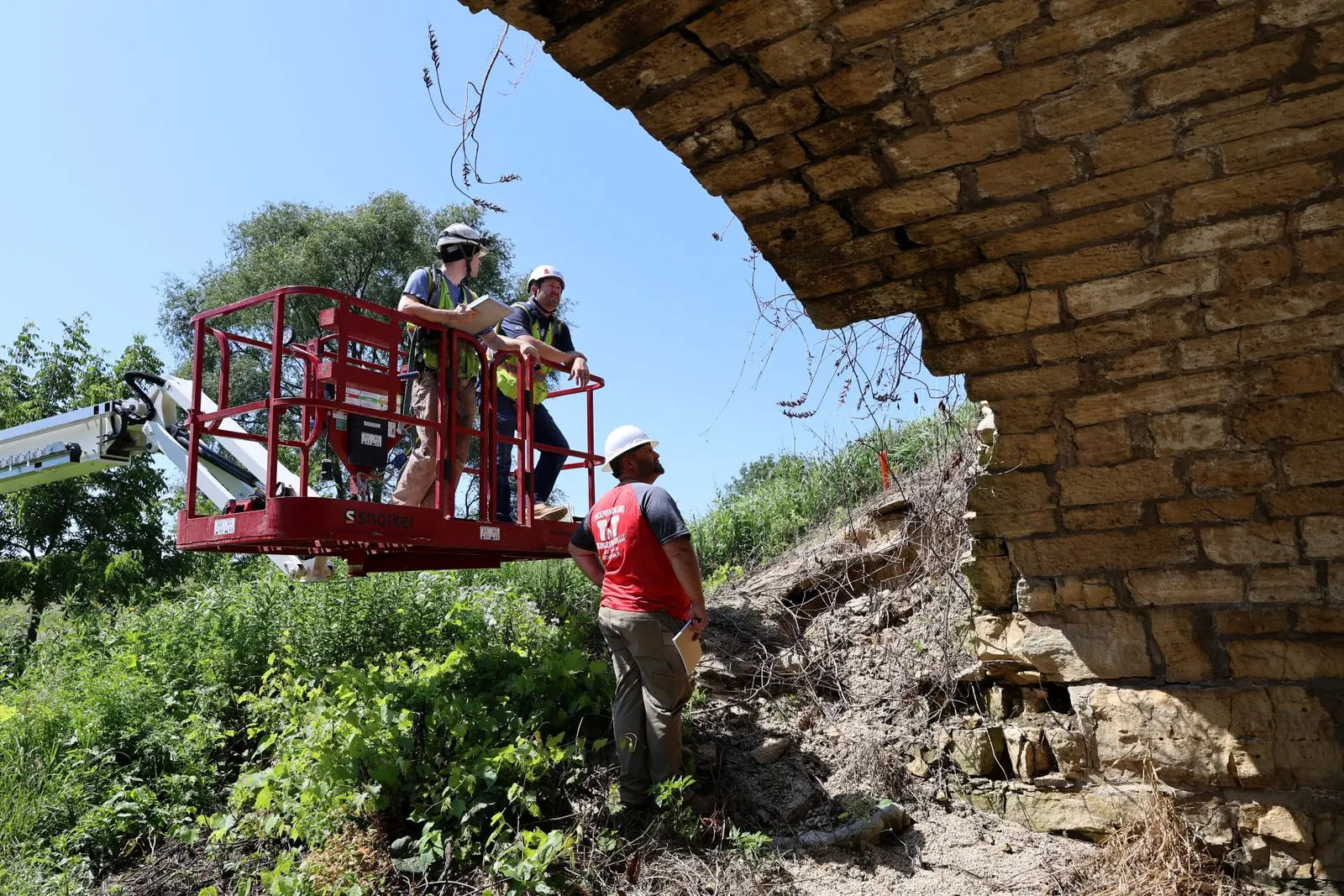
Wherever we can reach it, we reach it. A boom lift or scaffolding puts somebody physically on the masonry, and that is where the actual assessment happens, because most of what matters is tactile. How deep the mortar loss runs. Whether the mortar is harder than the stone around it. Whether the face of a stone is still bonded to what is behind it or has started to delaminate. We sound the masonry — tap across it and listen — because a void or a debonded face rings hollow and a solid one does not. There is no photograph that tells you that.
Alongside it we are recording joint condition, displacement and movement, water paths, vegetation and root intrusion, and what the previous repairs were actually made of. Your hands will tell you a mortar is too hard. Only a lab will tell you precisely what the original was, and you need that to match the replacement.
Then there is everything you cannot practically get to. On this bridge the west elevation took a lift. The east side and the south end sit over the creek, where staging at the investigation stage would have cost more than the investigation. That is where a drone earns its keep — two full surveys, 419 frames each, catching the arch soffits, spandrel faces and deck edges at angles no lift would reach. Roughly 930 photographs across the whole effort.
A drone is not a substitute for a hand on the stone. What it does is cover ground you cannot yet justify reaching, and tell you where the access money needs to go once the work starts. On a lot of buildings, that is the difference between an investigation an owner will pay for and one they will not.
Step 3: Look where the surface will not tell you enough
Some conditions only exist behind the face.
On an arch structure the questions live in the arch ring, the spandrel walls, and the fill behind and above them. On this bridge, the wall had already collapsed in several places — which is ugly, and also the most informative thing on the structure, because a collapse is a free section cut through the assembly. It exposed the deck build-up: a layer of cementitious fill over the arches, a gravel setting bed, and an eight-inch reinforced concrete slab above that. It also exposed large voids between the fill and the slab, running along the deck edges and out into the field of the deck — long-term settlement nobody could have seen from outside.
The finding that made the whole restoration viable came out of this stage too: the arches themselves are intact and sound, with no global structural movement, and the damage is concentrated in the outer 20 to 24 inches. That is the difference between a repair project and a replacement argument, and it is not a conclusion anybody reaches from a photo.
Step 4: Know what you are not, and who covers the rest
We are masonry restoration contractors. We are not structural engineers, we are not licensed to practice engineering, and we cannot stamp a drawing. If something on your building is moving, or if the repair depends on how load is being carried, that work belongs to a licensed structural engineer — and it should be an engineer from the start, not after somebody has already decided what the repair is going to be.
We say that plainly because the alternative is worse for you. A contractor who blurs that line is either working past what he is qualified for or is about to hand you a repair nobody has actually analyzed.
What we bring is the other half of it.
We have been restoring masonry since 1993, most of it on old buildings. We know what a hundred-and-thirty-year-old wall does when you start taking it apart. We know which mortar works with which stone and which one will quietly destroy it. We know what a repair detail costs, whether a crew can execute it on a lift forty feet up, and what sequence keeps a structure stable while it is open. We know what has been tried on buildings like yours and what failed.
None of that substitutes for engineering. It complements it — and the engineers we work best with are the ones who want that in the room early, while the repair approach is still taking shape, rather than after a detail is drawn that cannot be built.
On Ely's Stone Bridge, WJE was engineer of record and authored the condition assessment. We provided the access and documentation on site, then developed the costs, the shoring, the phasing and the schedule — and spent a lot of time answering how the repairs would actually get done. Two disciplines, neither pretending to be the other. More on that partnership in our WJE vendor spotlight.
Step 5: Write it down
The deliverable is a report, not a conversation.
Condition documented with photographs. Causes identified, not just symptoms listed. A recommended repair approach. A budget. And enough detail that somebody who was never on site can follow the reasoning from the condition to the number.
That document is what an owner takes to a board, a county, a grant application or a donor. If it will not survive that room, it was not worth commissioning.
It also produces findings nobody was looking for. On this bridge, the comparison against photographs from a 2016 assessment showed the deterioration had accelerated sharply — three sections of limestone had collapsed in the intervening years that were intact in 2016. That single comparison turned an open-ended preservation project into an urgent one, and it only exists because somebody had documented the structure ten years earlier.
Step 6: Phase it around the money
This is the part most people skip, and on preservation projects it is often the whole job.
Restoration money rarely arrives all at once. It comes in grants, in appropriations, in donations, over years. So the scope has to be built to be executed in pieces, and the pieces have to be ordered correctly.
One project is cheaper than three. Say so out loud. WJE's own recommendation on Ely's Stone Bridge is that the work is most cost effective as a single comprehensive project — mobilization efficiencies, and conditions get addressed before they worsen. Phasing is what you do when the money forces it, not what you recommend first.
Structural priority first. Whatever is actively getting worse goes first, regardless of what is most visible from the road.
Every phase is a stopping point. If the next round of funding takes three years, the structure has to be stable and weather-protected the whole time. On this bridge the recommendation is to start at the north end, terminate each phase above a pier so no arch is ever left half-supported, and install durable short-term weather protection over any opening left at the end of a work area.
Water before finish. Getting water out of the assembly protects everything you spend after it.
Assume the budget has to survive the wait. A scope priced against a documented condition report holds its shape for years. A scope built on a guess does not.
Ely's Stone Bridge is the live example. It is in poor condition and needs immediate repairs, the Commission is fundraising toward a Spring 2027 start, and every winter in between is another freeze-thaw season on stone that is already failing. That is the entire argument for investigating first — you cannot make a sequencing decision like that until you know what the whole thing costs. See the full write-up in the Ely Stone Bridge investigation.
What it costs you not to do this
An investigation is a line item. It is also the smallest line item in the project, and it is the only one that determines whether the rest of the money is well spent.
If your building is showing you something new, start there. Investigation & Budgeting and masonry investigations are built for exactly this, and project scope and budgeting assistance turns the findings into something you can fund. On historic structures it is the front end of every historic preservation project we take on.
Have a structure you need to understand? Request an assessment or call (563) 785-0120.
Frequently Asked Questions
What is a masonry investigation?
What does a restoration contractor add to an engineer's condition report?
How is a masonry investigation different from an estimate?
Do I need a design professional, a masonry contractor, or both?
How long does a masonry investigation take?
Can investigation results support grant applications or tax credit filings?
Learn More and See What’s Going On
Contact Us
Our skilled team is here to bring your building to life. Contact us today to discuss your project!