


Can Masonry Work Be Done in Cold Weather?
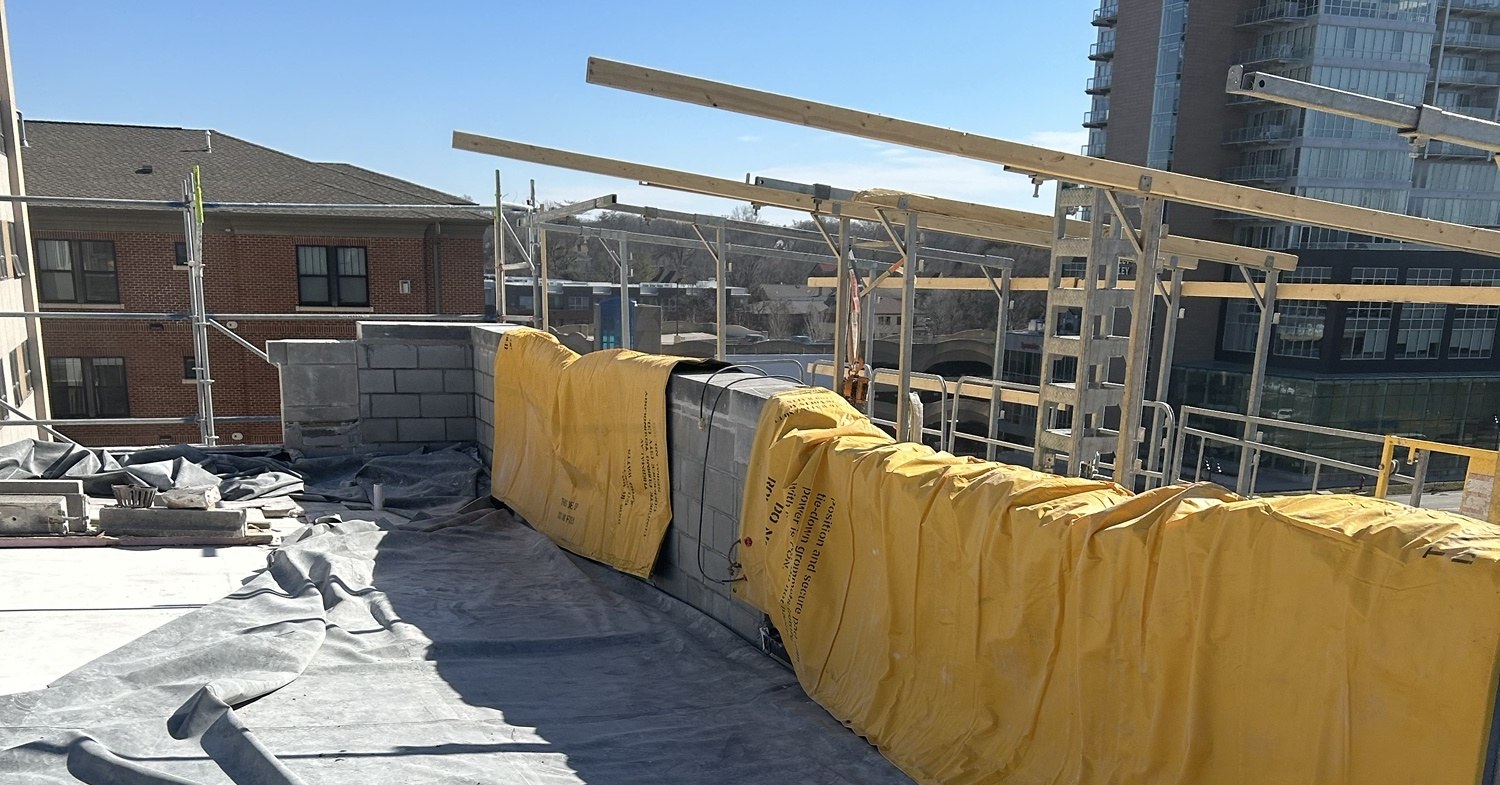
It's fall. You've got a wall that needs attention, and the contractor you called mentioned spring. That's a frustrating answer when you're the one who watched water come through a parapet last February.
Here's what's actually behind it — and where there's more room than you'd think.
Masonry restoration isn't limited by cold the way most people assume. Crews work in the cold all the time. What's limited is the material. Mortar, sealant, and coatings are chemistry, and chemistry has temperature requirements that don't move for anybody's schedule.
But the season isn't a wall you hit on a date. It's a slope, and a contractor who plans for it can extend it by weeks with fairly simple precautions. The difference between a company that stops when it gets cold and one that keeps producing good work into late November is almost entirely planning.
This article covers what's temperature-sensitive and what isn't, how the season actually gets extended, how we plan the end of one season and the start of the next, and how to decide where your project belongs.
How cold is too cold for masonry work?
Cold-weather masonry procedures start at 40 degrees Fahrenheit. Below that, mortar work requires added steps, and the requirements get more demanding the further the temperature drops.
Here's the part that matters for your building: the afternoon high doesn't tell you much. The industry standards look at the temperature over the day after the work goes in. We plan around the overnight low, because that's when fresh work is most exposed, and we look at the night after that too.
Mortar has to cure before it freezes. If fresh mortar freezes while it's still wet, the water in it expands and disrupts the joint before it's developed any strength. The bond it loses doesn't come back when it warms up. You get a joint that looks finished and isn't — and you usually won't find out for a year or two.
So a 48-degree Tuesday with a 26-degree Tuesday night is not automatically a good masonry day. It's a good masonry day if somebody has a plan for that wall overnight.
What's temperature-sensitive, and what isn't
Every material we put on a building has a temperature range on its data sheet, and those ranges aren't the same. In July it hardly matters. At the front and back end of the season, material selection becomes one of the most important decisions on the job. The right product for the conditions can buy weeks. The wrong one can cost you the repair.
Mortar and repointing — the most sensitive
This is the most weather-dependent work we do, and it's also the most commonly requested in the fall. Below 40 degrees, mortar work needs cold-weather procedures, and they get more involved the colder it gets. We follow the masonry industry's cold-weather procedures and the manufacturer's requirements for every product we use, and there's more room in them than most owners expect. The ladder is laid out below.
Repointing deserves extra care. A repointed joint is shallow, set into a wall that may have been cold for weeks, and the softer, lime-rich mortars older buildings need gain strength more slowly than the mortar used in new construction. That's what makes them right for the building. It's also why they need margin in cold weather, not shortcuts.
And there is still a point where exterior repair stops making sense. The colder it gets, the more it takes to protect the work, until finishing it correctly means a full heated enclosure. On a large elevation with a long schedule, that math can work. On a 200-square-foot patch, the protection can cost as much as the masonry itself, and it usually doesn't. Our masonry and concrete restoration crews plan the sequence around exactly this.
Sealant and caulking — more forgiving, with the right procedure
This is the one owners most often get backwards. Sealant can go in colder than most people expect, but not by ignoring the thermometer. Most masonry sealants list 40 degrees as the bottom of their normal range, and the manufacturers publish cold-weather procedures for working below it. We follow them. We keep the sealant warm so it guns and tools properly, and every joint gets the full prep: clean, dry, and free of frost before anything goes in. Some products, like certain silicones, are rated colder still. Check the specific product data sheet, because they vary a great deal.
The real constraints on cold-weather sealant work are substrate condition and cure time. You can't bond sealant to a joint face carrying frost or moisture, and frost can sit on a joint where you can't see it, especially in the morning. Cure slows as it gets colder, so fresh sealant needs to be left alone while it sets up. What sealant doesn't need is the multi-day protection window that mortar does.
There's one more cold-weather wrinkle. In the cold, masonry has contracted and the joints are at their widest, so sealant installed then will be squeezed as the wall warms up. Manufacturers want sealant installed near the middle of a joint's movement range. On most masonry joints that's manageable. On expansion joints that move a lot, it's worth weighing.
Put together, that's why sealant work is often one of the first things back on the calendar at the front end of a season. It can go in on the first workable days without a multi-day protection window behind it.
Water repellents and protective coatings — know the product's range
This is where material selection matters most at the edges of the season, because products in this category behave very differently in the cold. Penetrating water repellents soak into the masonry rather than forming a film on it, and some are rated for surprisingly cold surfaces. What they can't tolerate is water. The wall has to be dry, and in an Iowa fall a dry wall can be harder to find than a warm one. A repellent put on damp masonry doesn't get where it needs to go, and you've paid for protection you didn't get.
Film-forming coatings are the hardest to force. They typically need the air, the surface, and the material above the product's minimum, several degrees above the dew point, and no drop below that minimum for a day or two afterward. In an Iowa November you can usually get one or two of those, rarely all of them. A coating that doesn't cure fails at the bond, and the fix is removing it and doing it over.
Confirm minimum application temperature, dryness requirements, and cure window on the specific product data sheet. They are not consistent across products or even across one manufacturer's line.
Masonry cleaning — effectively a warm-weather activity
Most masonry cleaning is water-based. Cleaning a wall in late fall puts water into masonry that has no chance to dry before it freezes. That's the exact mechanism behind freeze-thaw damage. You'd be doing to the building on purpose what you're paying to protect it from.
The cleaners we use are rated for air and masonry at 40 degrees or above, and not for a day with a freeze expected that night. There's almost never a good reason to push cleaning into cold weather.
How a masonry contractor extends the season
This is the part most owners never hear, and it's where a good contractor earns the schedule.
Around early November — sometimes late October, depending on the year — we shift into cold-weather procedures. We follow the masonry industry's cold-weather procedures and each manufacturer's requirements, and it isn't one switch. It's a ladder, and we climb it as the forecast requires.
Step one: heat the mixing water. The simplest and most effective move there is. Heating the water means the mortar is already at an elevated temperature when it's prepared, so it goes into the wall warm and has a head start on curing before the temperature drops. For us, that step typically carries the work through most of November.
Step two: insulated blankets over the work. As it gets chillier, we cover completed work with insulated blankets at the end of the day. The blanket holds the heat the wall picked up during the day and the heat in the fresh mortar, and gets that mortar through the night it needs to survive.

Step three: electrically heated blankets. The next rung is insulated blankets with heating elements built in. They keep the wall actively warm overnight rather than just slowing heat loss, which buys more time, and the wall carries that heat into the following day's work. We also use them to warm masonry units before they're laid, so new brick or stone isn't going into the wall cold.
Step four: a full enclosure. Past that point, the work goes inside. We build an enclosure on the scaffold with poly sheeting and pump in heat to keep the wall and the mortar in range. It works, and it's how work gets finished in real cold. It's also real money, which is why it's a decision we make with the owner, not a default.
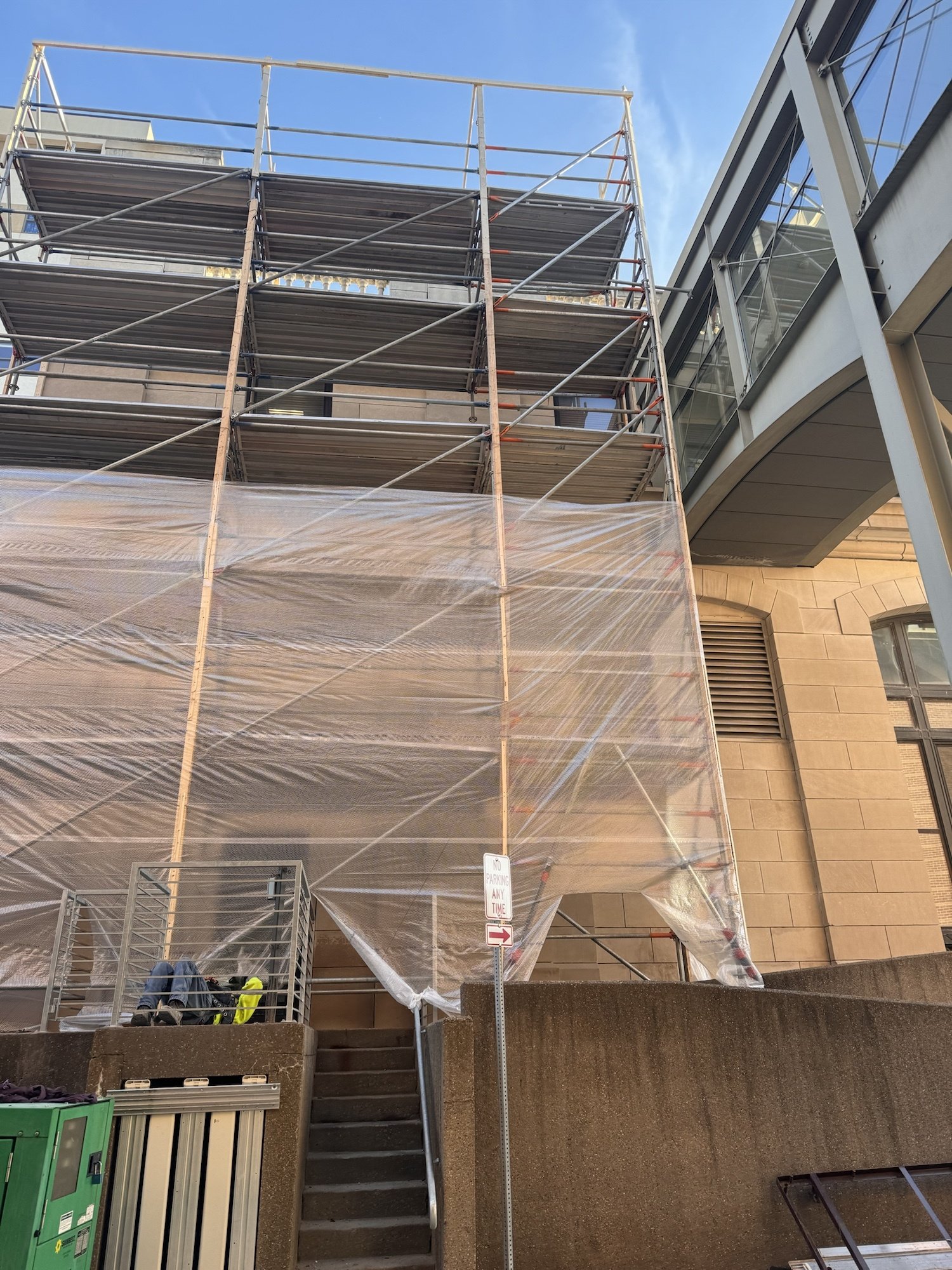
None of this is exotic. It's common-sense sequencing that has to be decided ahead of time — you can't order blankets the night the forecast turns. That's the real point. The contractors who produce good work in November are the ones who planned for November in August.
What good cold-weather work looks like on a jobsite
Every contractor handles the end of the season differently, and the difference is visible from the sidewalk if you know what to look for. If you're an owner with work happening in November, here's how to tell whether it's being done right.
- Mortar should be going into the wall warm. Ask what's being done about the mix — if nobody can tell you, nothing is.
- Completed work should be covered at the end of every day it needs it, not on the days somebody remembers. The covering goes on before the crew leaves, not the following morning.
- Somebody on that job should know tonight's low. Cold-weather masonry is a forecast-driven activity, and if the foreman isn't watching the forecast, the protection plan isn't real.
- The crew should be able to tell you the conditions at which they stop. A contractor without a stopping point doesn't have a procedure.
And the simplest test of all: if it's snowing and mortar is going into a wall with nothing covering it, that isn't cold-weather masonry. That's masonry in the cold, and they're different things. The first one is a plan. The second one is a schedule being met at your building's expense.
None of this is expensive. That's what makes it a fair thing to expect.
Planning the end of the season: we don't leave a building half-finished
Here's a commitment worth stating plainly, because it drives how we schedule the entire fall.
We don't like leaving a project sitting partially finished through the winter. A half-completed elevation is a building with open joints, incomplete protection, and staging in place for four months in the worst weather of the year. That's not a good position for an owner and it's not a good position for us.
So the fall schedule gets built backward from the freeze. When we take on a project in September or October, the question isn't just whether we can start it — it's whether we can finish it, with the cold-weather ladder above factored in. That's why the honest answer on some fall projects is that it belongs in the spring. Not because we can't start. Because we can't finish, and a project we can't finish shouldn't be started.
There's one exception, and it's a sensible one. Sometimes a major winter storm arrives when a project has a couple of days left. Forcing those last two days through a storm produces worse work than waiting. In that situation we'll pause, let the weather turn manageable — sometimes a few weeks — and go back and finish it properly. That's a planned pause on a nearly complete building, which is a very different thing from an elevation abandoned in November at forty percent.
Weather is the one variable nobody controls. What you can control is whether your plan has room in it for weather.
How cold-weather work gets priced
Owners ask about this less often than they should, so here is how it works on our jobs.
When we price work for late fall, the cold-weather precautions we expect to need are already in the number. Heating the mixing water and covering completed work with insulated blankets are not large additions to a project. They're part of doing the work in that window, so they belong in the bid, not in a change order in November.
What does become a significant cost is full-scale enclosure — tenting an elevation and heating it for a sustained period. That is real money, and it is not something we can absorb quietly. If a project reaches the point where an enclosure is the only way to finish it correctly, we come back to the owner, explain what it takes, and price it. Then it's a decision made together rather than a surprise.
Here's the practical takeaway for anyone comparing fall bids. If one number comes in noticeably lower than the others for the same November schedule, ask what cold-weather provisions are carried in it. A price built on September conditions for work happening in November isn't a lower price. It's an incomplete one, and the difference gets settled later — either as a change order, or as a repair that doesn't hold. Our commercial tuckpointing cost guide covers the other drivers behind a masonry number.
How the next season starts in February
The other half of managing a seasonal trade is starting the next one as early as possible. There's real work that isn't temperature-dependent, and it comes off the front of the spring schedule if it gets done in February.
Access comes first. By mid-February we like to start building access for upcoming projects — scaffold, staging, and equipment set — as long as conditions don't make it a safety concern. On many buildings, access is weeks of the schedule before a mason touches the wall. Moving that to February means the masonry starts the day the weather allows instead of three weeks after.
Prep work, when the forecast allows it. Removal work, like grinding out mortar joints or cutting out failed sealant, doesn't have the curing requirements that new material does, so on the right project some of it can get started early. But removal opens the wall up, and an open joint takes on water. So we watch the forecast closely and open up only as much as the weather will let us close back up before rain or snow can reach it. When the forecast doesn't cooperate, we don't force it.
The thread running through all of it: the work that can happen in the cold gets done in the cold, without leaving your building more exposed than we found it, so the work that needs weather is ready the moment the weather arrives. We wrote more about that in how off-season scheduling drives better project outcomes.
That only happens if the project is on the schedule before February. Which is the practical reason to have the conversation in the fall.
The risks of pushing work too late
When an owner asks a contractor to squeeze a job in and the contractor says yes without a plan for the cold, these are the things that go wrong. They're worth knowing because you're the one who absorbs them.
The repair fails early and quietly. Mortar that froze before it cured, a coating that never fully cured — neither looks wrong the day the crew leaves. They look finished. The failure shows up in year two or three, when the warranty conversation is complicated.
You can't inspect your own repair. Work completed in November disappears under winter. You don't get to watch how it performs through a wet spring, because by the time you can look closely it's already been through the hardest season of its life. Work completed in April gives you six months of observation before it faces a winter.
The cost goes up for the same work. Heat, blankets, enclosures, protection, and lost weather days are real line items. The same scope in April is often cheaper, and the April version doesn't carry the risk.
It gets done twice. The worst outcome, and not a rare one. You pay for the work, it fails inside a few years, and you pay again — for the repair and for the deterioration that happened while the bad repair was in place.
Four questions to decide where your project belongs
1. Does your building get worse over the winter if nobody touches it? Not whether it's broken — whether it deteriorates. Water is what makes it worse. Open head joints, failed sealant, a coping letting water into the top of a wall. Water gets in, freezes, expands, and takes a little more of the wall each cycle, and an Iowa winter delivers a lot of cycles. If the answer is yes, this is now work, and the cost of cold-weather protection is cheaper than the added deterioration.
2. Does the work require weather you're not going to get? Run the scope against the sections above. Mortar, coatings, and cleaning are strongly temperature-governed. Sealant installed with the right cold-weather procedure, prep work, and access are far less so.
3. Can it be finished, not just started? This is the question most owners don't ask and most contractors don't volunteer. A project that starts in November and can't finish is worse than a project that starts in April.
4. What happens to your budget if this moves? Your question, not the contractor's, and often the real driver. If money has to be spent this fiscal year, say so early. There are usually ways to structure the work so the assessment and the commitment happen now and the field work happens when conditions are right — which is what our investigation and budgeting work is built for.
The forward-thinking part
Everything above is a planning problem before it's a masonry problem. The temperature thresholds are the same for everybody in this trade. What differs is whether somebody was thinking about November in August, and about February in December.
That's the work we do before you ask us to. We watch the calendar against the schedule, we know which projects need to close out before the freeze and which ones need the cold-weather ladder, and we know what we can be doing in February to get your building started sooner. When we tell you spring, it's because we ran your project through all of it — not because we stopped answering the phone in November.
Some of that comes down to how far ahead you're looking. We've been doing this for more than thirty years, and we're building the company to be here for another hundred. That changes what you're willing to put your name on. A repair that fails in three years costs us more than the job was ever worth — in the building, in the relationship, and in what people say about us in a market this size. Prioritizing a repair that lasts over a schedule that's convenient isn't generosity on our part. It's the only version of this business that works over a long enough timeline.
If your building is showing you something — a crack, movement, staining, water where it shouldn't be — the answer isn't automatically now and it isn't automatically spring. It depends on what the building is doing and what the repair requires, and those are two different questions.
TNT Tuckpointing has worked on commercial, institutional, industrial, and historic masonry across Iowa and the Midwest since 1993. We'll tell you honestly which season your project belongs in, and we'd rather tell you spring than sell you a repair that won't hold. Reach out and we'll come walk the building with you.
Frequently Asked Questions
Can tuckpointing be done in the winter?
What temperature is too cold for masonry work?
How do masonry contractors work in cold weather?
What happens if mortar freezes before it cures?
Can caulking and sealant be installed in cold weather?
What masonry work can be done in February?
Is it cheaper to schedule masonry work in the spring?
How do I know if a masonry contractor is doing cold-weather work correctly?
Does cold-weather masonry work cost more?
Will my project be left unfinished over the winter?
Learn More and See What’s Going On

Contact Us
Our skilled team is here to bring your building to life. Contact us today to discuss your project!