


What Your Masonry Contractor Should Be Doing All Winter

From about Thanksgiving to the middle of February, commercial masonry in Iowa slows way down. Most crews come off buildings, scaffolding comes down, and the phone gets quiet.
What happens in that window is invisible to owners. It also has more to do with how your spring project goes than almost anything that happens in April. Here's what those weeks look like on our end, and what they mean for a building you're planning work on.
What slows down, and what doesn't
Temperature governs mortar, sealant, coatings and cleaning. Some work can keep going into the cold with the right cold-weather procedures, heated materials and enclosures. But it costs more, and the list of what's practical gets shorter every week. For most projects, for most of the winter, the right answer is to let the wall wait.
What doesn't slow down is everything that makes the field work go well once it starts. A contractor's winter is either productive or it isn't, and you inherit the result either way.
Training, while nobody is on a building
Winter is the only stretch of the year when you can put a whole crew through real training without pulling them off a job.
Our biggest example was a three-week Fraco training program, run inside our shop in Stockton, on the mast climbers and hoists we use: installation the first week, maintenance and troubleshooting the second, hoist installation and operator training the third. Mike Lee came out of it certified by Fraco to train our own crews, so we aren't waiting on a factory trainer's calendar when a project needs qualified operators.
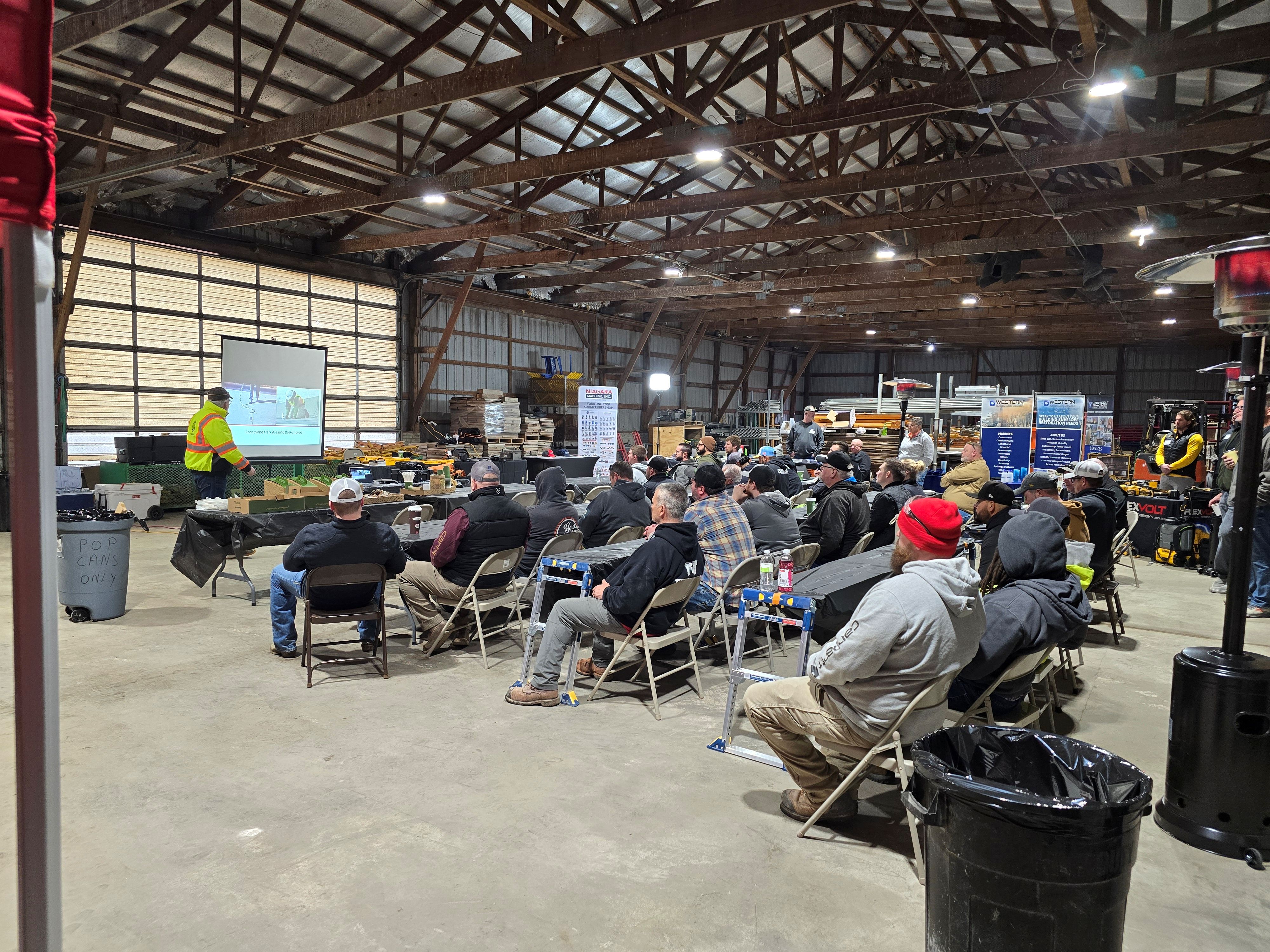
We open the shop to the rest of the industry, too. In March 2026 we cleared it out, fired up the heaters and hosted about forty contractors, engineers and manufacturers for the Iowa/Illinois ICRI Chapter's Concrete Surface Preparation Seminar: a morning in the classroom on concrete surface profiles, then an afternoon on the shop floor running grinders, scarifiers and shot blasters.
Try to schedule three weeks of training in July and it doesn't happen, for us or for anybody else. The payoff shows up on your building: a crew that trained in January is faster and safer on a mast climber in May.
Equipment, before it's needed
Scaffold, mast climbers, hoists, mixers, grinders, saws, lifts and trucks all come back to the shop after nine hard months. Winter is when they get inspected, serviced and repaired, so they're ready, not nearly ready.
Owners never see this, but it hits them directly. Equipment that breaks down in June costs days on a compressed schedule. The same repair in January costs nobody anything.
Planning: the part that decides your project
The most important thing that happens in the off-season is planning: scope, access, estimating and sequencing for the projects coming up.
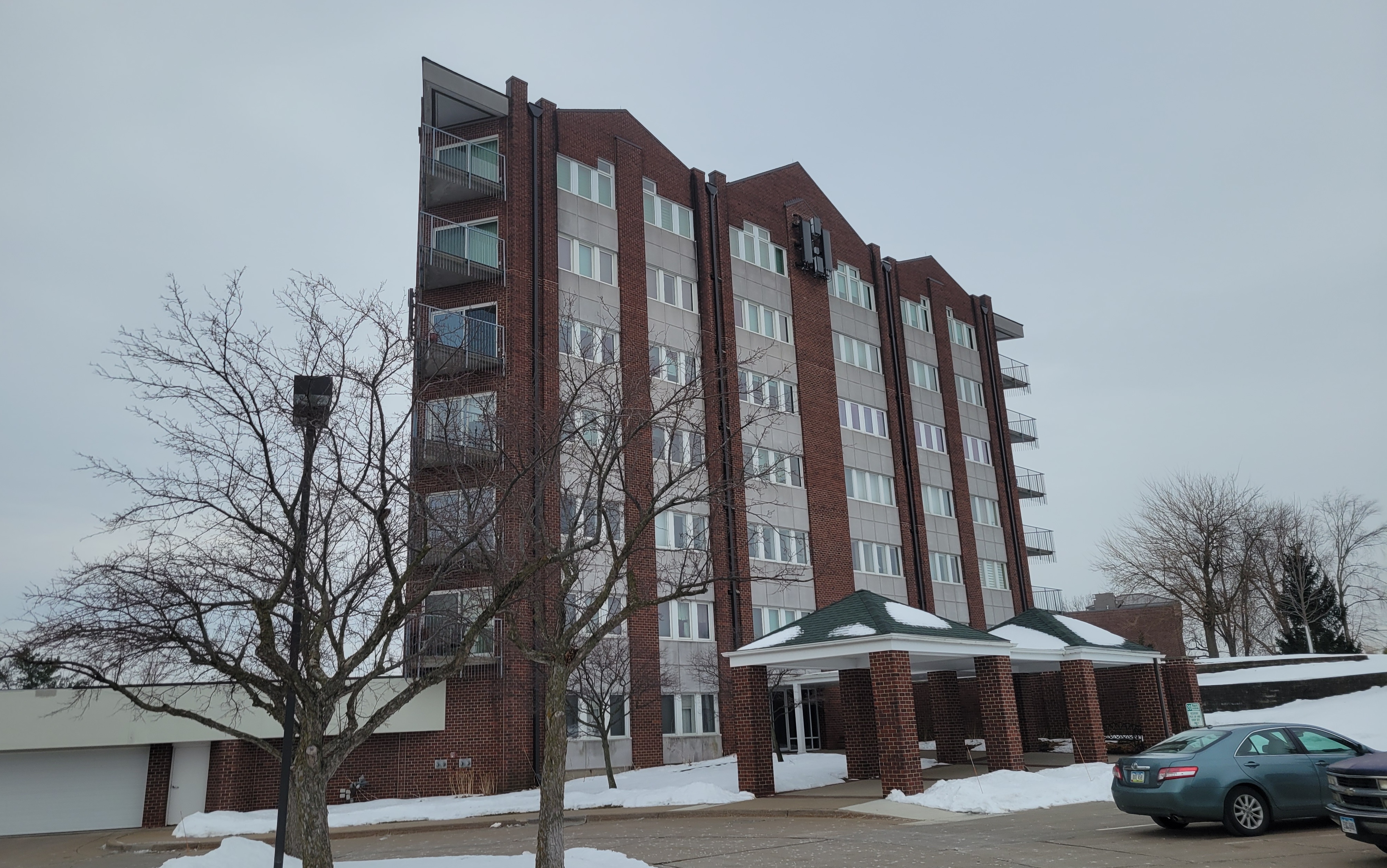
Here's what planning time buys. On a cell tower upgrade at 111 Cottage Grove in Cedar Rapids, every standard access approach was ruled out. The sloped roof eliminated swing stages. Steep landscaping made boom lifts a problem. Conventional scaffolding would have added time and brought its own safety concerns. And the work was high up, directly over an active parking garage, with finished landscaping below that had to be protected.
Each of the three elevations needed a different answer. On one, a small telehandler set Fraco ACT-8 mast climbing platforms, keeping the footprint light enough to spare the landscaping. On the second, over the garage, we shored the garage to carry the load, then brought in a crane to set the units on the garage roof. The third took the crane again, into a tight, confined space. Fraco engineered custom wall ties so we could anchor in the few areas that had room.
None of that gets solved on a Monday morning with a crew standing in the parking lot. It got solved months earlier, at a desk, with time to work through the options and get Fraco's engineers involved. When there's time to plan, we aren't reacting to problems on site. They're already solved.
How a spring schedule actually fills
Almost nobody explains this part to owners.
A masonry contractor's spring schedule fills in the winter. By the time the weather turns, the early-season slots are mostly committed to owners who had the conversation in November, December or January.
Then March arrives and everyone calls at once. Every facility director in the state looks outside, sees spring and picks up the phone the same week. Those projects get done, but in June and July rather than April, because the front of the season is already spoken for.
So the question isn't whether your project gets done. It's where in the season it lands. Starting early gets you three things:
- Schedule position. Early-season slots go to projects committed before the season starts. That isn't favoritism. It's arithmetic.
- Real planning time. The Cottage Grove solution exists because there were months to find it. A project that comes in March gets a good plan. One that comes in December gets a better one.
- Budget timing. School districts typically bid their summer work over the winter, so they can use leftover money in June and new money when the fiscal year turns over in July. A school that wants its project in that bid needs the scope and a real number before winter, which means now. Other owners run on their own cycles, but the logic is the same: the number has to exist before the money gets committed.
What the front of the season looks like
By mid-February we start moving again on the work that doesn't depend on temperature. Access comes first: scaffold, staging and equipment on the first projects of the season, as long as conditions are safe. On large repointing and sealant replacement jobs, some removal work can start early too, but only as much as the forecast lets us close back up before rain or snow can reach it.
That way the temperature-dependent work starts the day conditions allow, not three weeks later while a crew is still building scaffold. For an owner, that's the difference between finishing in early summer and finishing in late summer, and it's decided by a conversation the fall before.
What to do this fall and winter
Fall is the push to close buildings in. Whenever you can, get open joints sealed, failed caulking replaced and the worst leaks addressed before winter. Water that gets into a wall in November has all winter to freeze, thaw and do damage.
We also know that isn't always possible. Everyone is busy in the fall, and this year's budget may already be spent. If your building can't get done before winter, the next best move is to use the winter well.
That means using late fall and winter to get three things in place: a defined scope of work, a real budget and a signed contract. It starts with getting the building assessed: find out what you have, document the condition and get a real number. None of that depends on temperature, and it turns a vague line item into something a board can approve. That's what our investigation and budgeting work is built for.
Why push all the way to a contract, not just a number? Because a signed contract is what lets your contractor put you on the schedule and start planning. The more time a contractor has before mobilizing, the more gets done right:
- Materials. Mortar matched to the existing, products submitted and approved, and long-lead items ordered before anyone is waiting on them.
- Testing. Mortar analysis, cleaning test panels and sealant adhesion tests, done ahead of time instead of squeezed into the first week on site.
- Access and site logistics. The access plan for every elevation, where the staging areas go, how pedestrians get safely in and around the building, and what overhead protection the entrances and walkways need.
- Sequencing. Which elevation goes first and how the work stays out of the way of the people using the building.
- Permits. Sidewalk and right-of-way closures and city approvals, which rarely move as fast as anyone wants.
- Safety. Site-specific safety plans, fall protection and crew training for the equipment on that job, worked out before a crew shows up.
Preconstruction planning is the most important piece of a successful project. It's also the piece owners never see, and the first one that gets squeezed when a contract shows up in April.
That's why the best contractor for your building usually isn't the cheapest one. It's the one that is thoughtful and proactive: asking the hard questions before the bid, raising problems before they become change orders, and using the months before mobilization to plan the work.
Here's what that looks like. Before bidding the tuckpointing and retaining wall work at Cedar Rock State Park near Quasqueton, Iowa, home to a house designed by Frank Lloyd Wright, we asked the Iowa DNR for a pre-bid site meeting. Then in mid-March, with snow still on the ground, Josh Smyser and Jason Burg went back and flew a drone over the site to map it. That project is underway now.
Owners who get their scope, budget and contract in place over the winter start at the front of the season. Owners who start in March end up behind them, through no fault of their own.
TNT Tuckpointing has restored commercial, institutional, industrial and historic masonry across Iowa and the Midwest since 1993. If you're thinking about next season, now is the right time to start the conversation. Reach out and we'll come walk the building with you.
Frequently Asked Questions
What do masonry contractors do in the winter?
When should I schedule masonry work for next spring?
Why does my masonry project need to be planned months ahead?
Is winter a good time to get a masonry assessment?
When does masonry season start again in the spring?
Does a contractor's off-season affect the quality of my project?
Learn More and See What’s Going On

Contact Us
Our skilled team is here to bring your building to life. Contact us today to discuss your project!